
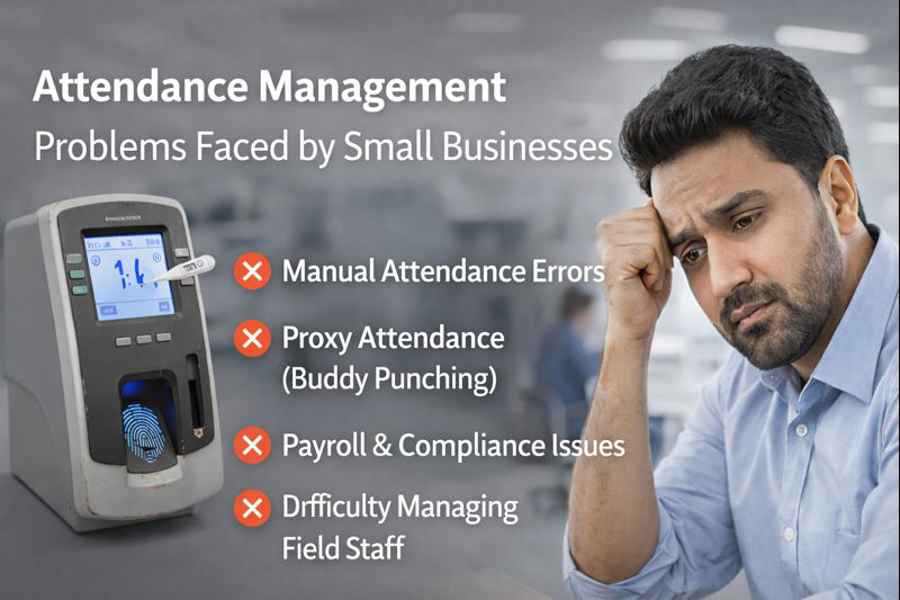
Common Attendance Management Problems Faced by Small Businesses in India
Common Attendance Management Problems Faced by Small Businesses in India
Managing employee attendance is one of the most common operational challenges for small businesses in India. While it may seem like a routine administrative task, attendance tracking directly affects productivity, payroll accuracy, compliance, and workforce discipline.
Many small and medium enterprises (SMEs) still rely on manual or semi-digital systems, which often create more problems than they solve. This article explores the most common attendance management issues faced by small businesses and why addressing them early is crucial for sustainable growth.
More attendance and payroll insights.
1. Manual Attendance Errors
One of the biggest challenges is the continued use of manual registers, Excel sheets, or basic punch machines without proper integration.
Common issues include:
- Incorrect entries
- Proxy attendance
- Missed punch-ins or punch-outs
- Time calculation mistakes
These errors accumulate over time and often result in payroll disputes, employee dissatisfaction, and loss of management control.
2. Proxy Attendance and Buddy Punching
In many workplaces, especially where supervision is limited, proxy attendance becomes a serious issue. Employees marking attendance for colleagues leads to inaccurate work-hour records and unfair payroll payouts.
This problem is especially common in:
- Manufacturing units
- Small offices
- Field-based teams
- Multi-shift environments
Without proper verification mechanisms, businesses struggle to ensure attendance authenticity.
3. Difficulty Managing Field Staff and Remote Teams
With the rise of mobile workforces, traditional attendance systems are no longer effective. Field executives, sales teams, and remote employees cannot be monitored using fixed-location devices.
Key challenges include:
- No visibility into actual working hours
- No location validation
- Delayed or inconsistent reporting
- Dependence on manual updates from employees
This lack of real-time data makes workforce planning and performance tracking extremely difficult.
4. Payroll Inaccuracies Due to Attendance Gaps
Attendance data forms the foundation of payroll processing. When attendance records are incomplete or inaccurate, payroll errors are inevitable.
Typical problems include:
- Overpayment or underpayment
- Incorrect overtime calculation
- Leave mismanagement
- Salary disputes at month-end
For small businesses, these issues not only waste time but also damage employee trust.
How attendance mistakes lead to payroll disputes.
5. Compliance Challenges (PF, ESI, PT, Labour Laws)
Indian labour compliance depends heavily on accurate attendance and wage records. Poor attendance tracking can expose businesses to compliance risks.
Challenges faced by SMEs:
- Incomplete audit-ready records
- Difficulty justifying wage calculations
- Risk during inspections
- Errors in statutory filings
Many businesses realize these risks only when faced with audits or penalties.
6. Lack of Real-Time Visibility for Management
Small business owners often wear multiple hats and cannot monitor attendance daily. Without centralized, real-time dashboards, decision-making becomes reactive rather than proactive.
This results in:
- Late identification of absenteeism trends
- Poor workforce utilization
- Difficulty planning shifts and workloads
Real-time visibility is essential for maintaining operational discipline.
7. Scalability Issues as the Business Grows
What works for a 5-person team rarely works for a 50-person organization. As businesses expand, attendance complexity increases across departments, locations, and shifts.
Common scaling problems include:
- Managing multiple registers or files
- Inconsistent attendance policies
- No historical data for analysis
- Increased administrative workload
Without a scalable system, growth creates chaos instead of efficiency.
8. Time Wasted on Administrative Follow-Ups
HR teams and business owners often spend unnecessary time:
- Chasing attendance corrections
- Verifying leave records
- Resolving payroll disputes
- Manually consolidating reports
This time could be better spent on employee engagement, hiring, or business development.
9. Low Transparency and Employee Trust Issues
When attendance and payroll data are unclear, employees lose confidence in the system. Transparency issues often lead to:
- Frequent disputes
- Reduced morale
- Perception of unfair treatment
A clear, accurate attendance system helps build trust between management and employees.
Why Solving Attendance Problems Matters
Attendance management is not just about marking presence. It directly impacts:
- Payroll accuracy
- Compliance safety
- Employee discipline
- Operational efficiency
- Long-term scalability
For small businesses in India, addressing attendance challenges early creates a strong foundation for sustainable growth.
Explore more HR and attendance tips.
Final Thoughts
Attendance-related issues are common, but they are not unavoidable. Understanding the root causes is the first step toward building better systems and processes.
As Indian small businesses modernize operations, adopting structured, transparent, and scalable attendance practices becomes essential—not just for efficiency, but for compliance and trust as well.
Frequently Asked Questions
1. What is the biggest attendance management problem for small businesses?
Answer: The most common issue is manual errors — from incorrect entries to proxy attendance — which snowball over time and affect payroll accuracy, compliance, and employee trust.
2. How does poor attendance tracking affect payroll accuracy?
Answer: Incomplete or inaccurate attendance data leads to time calculation mistakes, improper overtime accounting, and mismanaged leave balances, which directly translate into payroll inaccuracies and frequent disputes.
3. Can attendance software solve attendance challenges in remote teams?
Answer: Yes. Modern attendance apps with GPS or mobile features enable visibility into hours worked, location verification, and real-time reporting for field staff and remote teams — eliminating many of the limitations of traditional systems.
4. What compliance risks arise from poor attendance management?
Answer: Inaccurate attendance records can result in incomplete labour law documentation, difficulties during audit checks, errors in statutory filings (like PF/ESI), and potential penalties under Indian compliance requirements.
5. How do SMEs combat proxy attendance and buddy punching?
Answer: Using digital systems with secure login, GPS verification, and device authentication helps prevent proxy attendance and improves record integrity. These tools also leave an audit trail for accountability.