
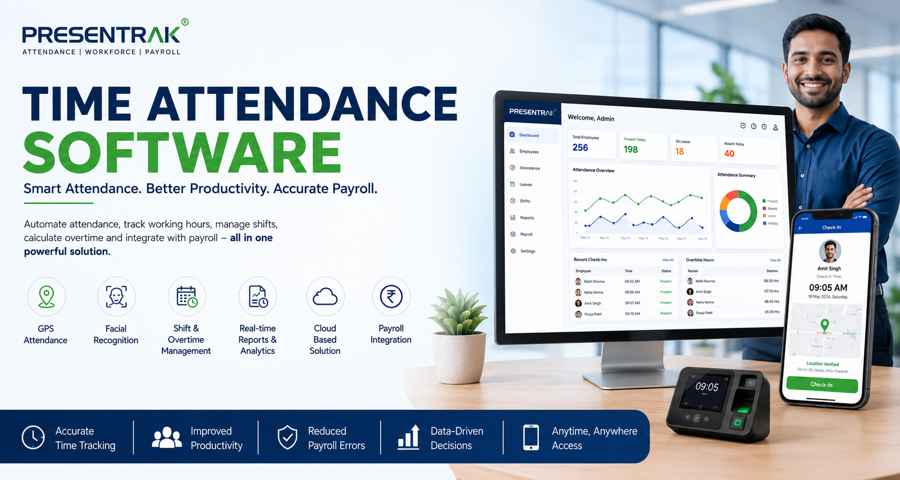
Best Time Attendance Software in India (2026): Complete Business Guide
Time Attendance Software: Complete Guide for Businesses in India (2026)
In Short
Time attendance software helps businesses accurately record employee working hours, shifts, overtime, breaks, and attendance while reducing manual errors and simplifying payroll processing. Whether you manage an office, factory, retail store, hospital, construction site, or remote workforce, the right time attendance software improves workforce visibility, increases productivity, and supports business growth.
Introduction
As businesses grow, managing employee working hours becomes more challenging. What starts as a simple attendance register or Excel spreadsheet often turns into payroll discrepancies, attendance disputes, inaccurate overtime calculations, and lost productivity.
Many businesses still rely on manual attendance methods that consume valuable administrative time every month. HR teams spend hours verifying attendance records, managers struggle to monitor multiple locations, and payroll processing becomes more complex as the workforce expands.
Modern businesses need more than just recording employee presence. They need a reliable system that accurately captures working hours, shift timings, overtime, leave, remote attendance, and field employee activity—all while integrating seamlessly with payroll.
This is where Time Attendance Software plays a crucial role.
Instead of simply recording whether an employee is present or absent, a modern time attendance system helps businesses monitor employee working hours in real time, automate attendance calculations, reduce payroll errors, and improve overall workforce management.
Whether employees work from an office, factory, retail outlet, construction site, hospital, educational institution, or remote location, cloud-based time attendance software provides greater accuracy, transparency, and operational efficiency.
As businesses across India continue adopting digital HR solutions, time attendance software has become an essential part of modern attendance management and payroll automation rather than just another HR tool.
What Is Time Attendance Software?
Time Attendance Software is a digital workforce management solution that automatically records employee working hours, attendance, shift timings, overtime, breaks, leave, and clock-in/clock-out activities from a centralized platform.
Unlike traditional attendance registers or spreadsheets, modern time attendance software automates attendance recording while providing real-time visibility into workforce activities across multiple offices, branches, or job sites.
A complete time attendance system typically manages:
• Employee clock-in and clock-out
• Daily attendance records
• Working hours calculation
• Shift management
• Overtime calculation
• Break management
• Leave management
• Late arrivals and early departures
• Holiday calendars
• Attendance reports
• Payroll-ready attendance data
Many modern attendance software solutions also support mobile attendance, GPS attendance, biometric devices, facial recognition attendance, QR-based attendance, and kiosk attendance, allowing businesses to manage both office-based and field employees efficiently.
For growing businesses, integrating attendance management with payroll significantly reduces manual work and improves salary accuracy while ensuring compliance with company attendance policies.
Why Time Attendance Software Is Becoming Essential for Modern Businesses
Businesses today operate differently than they did a few years ago.
Employees may work from multiple offices, customer locations, retail stores, factories, construction sites, or even remotely. Managing attendance manually in such environments is no longer practical.
Some of the common challenges businesses face include:
• Manual attendance errors
• Proxy or buddy punching
• Inaccurate overtime calculations
• Difficulty managing multiple branches
• Delayed payroll processing
• Lack of real-time attendance visibility
• Employee attendance disputes
• Time-consuming HR administration
Time attendance software solves these challenges by automatically collecting attendance data, calculating working hours, generating attendance reports, and preparing accurate attendance information for payroll processing.
Instead of spending valuable time correcting attendance records every month, HR teams can focus on employee engagement, compliance, and business growth.
How Does Time Attendance Software Work?
Although different attendance software solutions offer different features, the basic workflow remains similar. A modern time attendance system automates the complete attendance lifecycle—from employee check-in to payroll-ready reports.
Step 1: Employee Records Attendance
Employees record their attendance using one or more approved methods, such as:
- Mobile Attendance App
- GPS Attendance
- Facial Recognition Attendance
- Biometric Device
- QR Code Attendance
- Kiosk Attendance
- Web Check-in
The attendance is captured instantly and stored securely in the cloud.
Step 2: Working Hours Are Calculated Automatically
Once attendance is recorded, the software automatically calculates:
- Total working hours
- Shift timings
- Late arrivals
- Early departures
- Break duration
- Overtime hours
- Half-day attendance
- Weekly off calculations
This eliminates manual calculations and reduces payroll errors.
Step 3: Attendance Data Is Verified
Managers and HR teams can review attendance in real time.
They can:
- Approve attendance corrections
- Review missed punches
- Verify overtime requests
- Approve leave applications
- Monitor employee availability
Because everything is recorded digitally, attendance disputes become much easier to resolve.
Step 4: Reports Are Generated Instantly
Instead of manually preparing attendance reports at the end of every month, businesses can generate reports with just a few clicks.
Common reports include:
- Daily Attendance Report
- Monthly Attendance Report
- Employee Working Hours Report
- Overtime Report
- Late Coming Report
- Shift Attendance Report
- Leave Summary
- Department-wise Attendance
These reports help HR teams monitor attendance trends and improve workforce planning.
Step 5: Payroll Processing Becomes Easier
One of the biggest advantages of modern time attendance software is payroll integration.
Since attendance records are already calculated, payroll processing becomes much faster.
The software can automatically provide payroll-ready information such as:
- Payable days
- Overtime hours
- Leave deductions
- Late penalties (if applicable)
- Holiday calculations
- Shift allowances
This significantly reduces manual work while improving salary accuracy.
Key Benefits of Time Attendance Software
Businesses often invest in attendance software to save time, but the long-term benefits extend far beyond attendance recording.
1. Eliminates Manual Attendance Errors
Manual attendance registers and spreadsheets are prone to mistakes.
Common issues include:
- Incorrect attendance entries
- Missing attendance records
- Duplicate records
- Calculation errors
- Human oversight
Time attendance software records attendance automatically, improving accuracy and reducing administrative effort.
2. Saves Valuable HR Time
HR teams often spend several days every month:
- Verifying attendance
- Correcting attendance mistakes
- Preparing payroll data
- Calculating overtime
- Resolving employee disputes
Automation significantly reduces repetitive administrative work, allowing HR professionals to focus on higher-value activities.
3. Improves Payroll Accuracy
Attendance directly affects payroll.
Incorrect attendance can result in:
- Wrong salary calculations
- Incorrect overtime payments
- Leave deduction mistakes
- Employee dissatisfaction
By integrating attendance with payroll, businesses can process salaries more accurately and efficiently.
Read more: Attendance & Payroll Software
4. Better Visibility Across Multiple Locations
Many businesses operate across multiple offices, factories, retail stores, warehouses, or project sites.
A cloud-based time attendance system allows managers to monitor attendance from a single dashboard without visiting every location.
This is particularly useful for businesses with distributed teams or multiple branches.
5. Supports Mobile and Field Employees
Modern businesses increasingly employ remote staff, sales teams, service engineers, delivery personnel, and field executives.
Instead of relying on manual reporting, mobile-based time attendance software allows employees to record attendance directly from their smartphones.
When combined with GPS verification, businesses gain greater confidence that attendance is being recorded from approved work locations.
learn more: GPS Attendance System
6. Reduces Buddy Punching and Attendance Fraud
Traditional attendance methods often allow employees to mark attendance on behalf of others.
Modern attendance systems help reduce this problem through technologies such as:
- Facial Recognition Attendance
- Biometric Authentication
- GPS Location Verification
- Kiosk Attendance
- Device Authentication
These features improve attendance reliability while increasing accountability.
More details: Facial Recognition Attendance
7. Simplifies Shift and Overtime Management
Businesses operating multiple shifts often struggle with manual calculations.
Time attendance software automatically manages:
- Day shifts
- Night shifts
- Rotational shifts
- Flexible working hours
- Overtime calculations
- Holiday shifts
This ensures consistency across departments while reducing payroll complexities.
8. Generates Actionable Workforce Insights
Attendance data is more than just a record—it provides valuable operational insights.
Managers can quickly identify:
- Frequent late arrivals
- High absenteeism
- Overtime trends
- Department-wise attendance
- Workforce utilization
- Attendance compliance
These insights help businesses make informed workforce management decisions.
Why Businesses in India Are Switching to Cloud-Based Time Attendance Software
Indian businesses are increasingly replacing registers and desktop-based attendance systems with cloud solutions because they offer greater flexibility and scalability.
Cloud-based time attendance software enables businesses to:
- Access attendance data anytime, anywhere
- Manage multiple branches from one platform
- Support office and remote employees
- Scale as the workforce grows
- Reduce IT maintenance costs
- Receive regular software updates
- Improve data security and backup
For growing businesses, cloud technology makes attendance management simpler, more reliable, and better suited to modern workforce requirements.
Essential Features Every Time Attendance Software Should Have
Choosing time attendance software isn't just about recording employee check-ins and check-outs. The right solution should simplify attendance management, improve workforce visibility, and integrate seamlessly with payroll operations.
Before selecting a solution, businesses should evaluate whether the software includes the following essential features.
1. Multiple Attendance Recording Methods
Every business has different workforce requirements. While office employees may use facial recognition or biometric devices, field teams often require mobile attendance with location verification.
A modern time attendance software should support multiple attendance methods, including:
- Mobile Attendance
- GPS Attendance
- Facial Recognition Attendance
- Biometric Attendance
- QR Code Attendance
- Kiosk Attendance
- Web Attendance
Supporting multiple attendance options allows businesses to manage office staff, remote employees, and field teams using a single attendance platform.
More sources on:
2. Shift Management
Many industries operate beyond the standard 9-to-5 schedule.
Factories, hospitals, retail stores, and customer support teams often work in multiple shifts, making manual attendance management difficult.
An ideal time attendance system should support:
- Day shifts
- Night shifts
- Rotational shifts
- Flexible working hours
- Weekly off schedules
- Holiday calendars
Automated shift management reduces administrative effort while ensuring accurate attendance calculations.
3. Automated Working Hour Calculation
One of the biggest advantages of digital attendance software is automatic working hour calculation.
Instead of manually calculating attendance every month, the software automatically determines:
- Total working hours
- Productive hours
- Late arrivals
- Early departures
- Break duration
- Overtime hours
This improves payroll accuracy while eliminating repetitive calculations.
4. GPS Attendance for Field Employees
Businesses with sales teams, service engineers, delivery executives, or field staff require more than basic attendance recording.
GPS-enabled attendance allows employees to mark attendance from approved work locations while giving managers greater visibility into field operations.
This feature is particularly useful for:
- Sales Teams
- Construction Companies
- Service Businesses
- Logistics Companies
- Marketing Teams
- Maintenance Staff
GPS attendance reduces attendance disputes and improves workforce accountability.
Live Employee Tracking with PresenTrak: Smarter Workforce Monitoring
5. Facial Recognition Attendance
Traditional attendance methods are vulnerable to proxy attendance and buddy punching.
Facial recognition technology verifies the employee's identity before recording attendance, helping businesses improve attendance accuracy without requiring physical contact.
It is especially suitable for:
- Offices
- Factories
- Educational Institutions
- Hospitals
- Retail Stores
Facial recognition attendance also provides a faster and more hygienic attendance experience compared to conventional biometric systems.
Why Businesses Are Moving Toward Face Recognition Attendance Systems for Better Workforce Management
6. Attendance Reports and Analytics
Attendance data becomes valuable only when it can be analyzed effectively.
A modern attendance management system should provide comprehensive reports such as:
- Daily Attendance Report
- Monthly Attendance Summary
- Late Arrival Report
- Overtime Report
- Leave Report
- Shift Report
- Employee Attendance History
- Department-wise Attendance
These reports help HR teams monitor attendance trends, identify operational issues, and make informed workforce decisions.
7. Leave Management Integration
Attendance and leave management are closely connected.
Without integrated leave management, HR teams often spend additional time reconciling attendance records with approved leave requests.
Integrated leave management enables businesses to:
- Apply for leave online
- Approve leave digitally
- Track leave balances
- Reduce attendance discrepancies
- Maintain accurate payroll calculations
8. Payroll Integration
Attendance directly influences salary processing.
Integrating attendance software with payroll reduces manual work by automatically preparing payroll-ready attendance data.
Payroll integration helps automate calculations such as:
- Payable Days
- Overtime
- Leave Deductions
- Holiday Pay
- Shift Allowances
- Attendance-Based Salary Adjustments
Businesses processing payroll every month benefit significantly from accurate attendance records.
Suggested topic: Attendance & Payroll Software
9. Employee Self-Service (ESS)
Employee Self-Service allows employees to manage attendance-related activities without depending on HR for every request.
Typical ESS features include:
- View attendance history
- Download attendance reports
- Apply for leave
- View leave balance
- Check shift schedules
- Correct missed punches
- Track attendance approvals
Self-service improves transparency while reducing HR workload.
Detailed Guide on Employee Self-Service
10. Cloud Accessibility
Modern businesses require attendance data that is accessible from anywhere.
Cloud-based time attendance software allows authorized users to:
- Monitor attendance remotely
- Manage multiple branches
- Access reports instantly
- Approve attendance while travelling
- Track workforce activity in real time
Cloud deployment also simplifies software updates, improves data security, and reduces IT maintenance costs.
Time Attendance Software vs Attendance Tracking Software
Although these terms are often used interchangeably, they are not exactly the same.
| Time Attendance Software | Attendance Tracking Software |
|---|---|
| Records employee working hours | Focuses on attendance status and monitoring |
| Calculates shifts and overtime | Primarily tracks attendance events |
| Supports payroll integration | May require additional payroll integration |
| Suitable for complete workforce management | Suitable for attendance monitoring |
| Includes time-based analytics | Primarily attendance-focused reports |
Many modern cloud solutions combine both capabilities into a single platform, allowing businesses to manage attendance, working hours, leave, shifts, and payroll from one centralized system.
Time Attendance Software vs Time Tracking Software
Businesses often confuse time attendance software with time tracking software, but they serve different purposes.
| Time Attendance Software | Time Tracking Software |
|---|---|
| Records employee attendance | Records time spent on specific tasks or projects |
| Calculates working hours | Measures project or task duration |
| Supports payroll processing | Supports project management and billing |
| Used by HR and operations teams | Used by project managers and freelancers |
| Helps manage workforce attendance | Helps measure productivity and project costs |
For businesses managing employees across offices, factories, retail stores, hospitals, or field locations, time attendance software is generally the more appropriate solution because it supports workforce management and payroll operations rather than project billing alone.
Excellent. This is the commercial decision-making phase, where readers are evaluating software. It targets "best time attendance software", "time attendance software India", and commercial search intent while naturally supporting your comparison pages and industry pages.
How to Choose the Right Time Attendance Software for Your Business
Not every business requires the same attendance solution. A small office with ten employees has very different requirements than a manufacturing unit operating three shifts or a construction company managing employees across multiple project sites.
Instead of choosing software based only on popularity or price, businesses should evaluate solutions based on their workforce structure, operational requirements, and long-term scalability.
The following factors can help you make a more informed decision.
1. Understand Your Workforce
The first step is understanding where and how your employees work.
For example:
- Office-based employees may only require facial recognition or kiosk attendance.
- Field employees benefit from GPS-enabled mobile attendance.
- Factory workers often require biometric or facial recognition devices integrated with shift management.
- Retail businesses usually need multi-branch attendance monitoring.
- Construction companies require location-based attendance with real-time workforce visibility.
Selecting software that matches your workforce model reduces implementation challenges and improves employee adoption.
2. Look Beyond Basic Attendance Recording
Many businesses purchase attendance software that simply records employee check-ins.
However, modern businesses require much more than attendance marking.
Look for software that includes:
- Shift Management
- Leave Management
- Overtime Calculation
- Attendance Reports
- Payroll Integration
- Employee Self-Service
- Mobile Attendance
- GPS Attendance
- Multi-Branch Management
These features eliminate manual work and help businesses scale efficiently.
3. Choose Cloud-Based Time Attendance Software
Cloud technology has changed the way businesses manage attendance.
Unlike desktop software that is restricted to one location, cloud-based attendance software allows authorized users to access attendance information from anywhere.
Benefits include:
- Real-time attendance visibility
- Automatic software updates
- Secure cloud backup
- Multi-location management
- Lower maintenance costs
- Easy scalability
Cloud deployment is particularly valuable for businesses with multiple offices or distributed teams.
4. Ensure Payroll Integration
Attendance and payroll should never operate as separate systems.
If attendance data has to be manually exported into payroll every month, businesses lose valuable time and increase the chances of salary errors.
An integrated solution should automatically calculate:
- Payable Days
- Overtime
- Leave Deductions
- Shift Allowances
- Holiday Pay
- Attendance-Based Salary Components
This significantly reduces payroll processing time while improving accuracy.
Attendance & Payroll Software
5. Evaluate Mobile Attendance Capabilities
Today's workforce is increasingly mobile.
Sales executives, technicians, delivery teams, project managers, and service engineers rarely work from a fixed office location.
Mobile attendance software allows employees to:
- Mark attendance using smartphones
- Record attendance remotely
- Submit attendance while travelling
- Synchronize attendance instantly
For businesses managing field operations, mobile attendance has become a necessity rather than an optional feature.
6. Check Reporting and Analytics
Attendance reports should do more than simply display employee attendance.
A good time attendance software should provide actionable business insights.
Examples include:
- Employee attendance trends
- Department-wise reports
- Shift utilization
- Overtime analysis
- Absenteeism reports
- Late arrival reports
- Productivity indicators
These reports support better workforce planning and informed business decisions.
7. Consider Future Business Growth
The software you choose today should continue supporting your business as it grows.
Questions to consider include:
- Can the software handle additional employees?
- Does it support multiple branches?
- Can new locations be added easily?
- Will it support future attendance methods?
- Is it suitable for hybrid work environments?
Choosing scalable software reduces future migration costs and operational disruptions.
Which Industries Benefit Most from Time Attendance Software?
Although every organization records attendance, certain industries benefit significantly from automated time attendance systems due to larger workforces, multiple shifts, field operations, or strict compliance requirements.
Offices and Corporate Businesses
Corporate organizations use time attendance software to automate attendance, improve payroll accuracy, manage hybrid work models, and reduce manual HR administration.
Useful features include:
- Mobile Attendance
- Facial Recognition
- Employee Self-Service
- Attendance Reports
- Payroll Integration
Complete guide on : Attendance & Payroll Software for Offices & Corporate Businesses
Manufacturing and Factories
Factories often operate multiple production shifts, making manual attendance management difficult.
Time attendance software helps manufacturers manage:
- Multiple Shifts
- Overtime
- Contract Employees
- Shift Rotation
- Production Workforce Attendance
Suggested Internal Link: Factory Attendance Software
Construction Companies
Construction businesses frequently employ workers across multiple project sites.
GPS-enabled attendance allows supervisors to verify attendance from approved work locations while monitoring workforce availability in real time.
Recommended features:
- GPS Attendance
- Mobile Attendance
- Project-wise Attendance
- Location Verification
Construction Workforce Attendance Software
Retail Businesses & Showrooms
Retail organizations typically manage multiple stores with rotating staff.
Time attendance software simplifies:
- Shift Scheduling
- Multi-Store Attendance
- Late Arrival Monitoring
- Weekly Off Management
- Payroll Preparation
Complete guide on : Retail Businesses Attendance Software
Hospitals and Healthcare
Healthcare organizations require accurate attendance management because they often operate around the clock.
Useful capabilities include:
- Shift Management
- Emergency Shift Scheduling
- Attendance Compliance
- Department-wise Reports
- Overtime Calculation
learn more on Attendance & Payroll Software Built for Hospitals & Healthcare Organizations
Schools and Educational Institutions
Educational institutions use attendance software to manage teaching staff, administrative employees, and support teams.
Common benefits include:
- Staff Attendance
- Shift Management
- Leave Tracking
- Payroll Support
- Attendance Reporting
Why More Indian Businesses Are Switching to Digital Time Attendance Systems
Across India, businesses are replacing attendance registers, spreadsheets, and standalone biometric machines with cloud-based attendance solutions.
The reasons are straightforward:
- Reduced administrative work
- Faster payroll processing
- Improved attendance accuracy
- Better workforce visibility
- Simplified compliance
- Support for hybrid and remote work
- Easier multi-location management
As businesses continue to digitize their HR operations, time attendance software has evolved from a convenience into an essential operational tool for managing a modern workforce.
Frequently Asked Questions (FAQs)
1. What is Time Attendance Software?
Time attendance software is a digital system that records employee working hours, attendance, shift timings, overtime, and leave while helping businesses automate attendance management and simplify payroll processing. Modern solutions also support mobile attendance, GPS tracking, facial recognition, biometric devices, and cloud-based attendance management.
2. How is Time Attendance Software different from Attendance Management Software?
Time attendance software primarily focuses on recording employee working hours, clock-in and clock-out times, shifts, and overtime.
Attendance management software is a broader solution that includes attendance tracking along with leave management, shift scheduling, employee attendance reports, payroll integration, and workforce management.
Today, many cloud-based solutions combine both functionalities into a single platform.
3. Is Time Attendance Software suitable for small businesses?
Yes. Small businesses often benefit the most because attendance automation reduces manual work, minimizes payroll errors, and saves valuable administrative time.
Cloud-based software also eliminates the need for expensive infrastructure while allowing businesses to scale as they grow.
4. Can Time Attendance Software manage multiple office locations?
Yes. Most modern cloud-based attendance systems allow businesses to manage attendance across multiple offices, factories, retail outlets, warehouses, or project sites from a single dashboard.
Managers can monitor attendance in real time regardless of employee location.
5. Does Time Attendance Software support remote and field employees?
Yes. Many businesses use GPS-enabled mobile attendance for employees who work outside the office, such as sales teams, service engineers, construction workers, delivery executives, and field technicians.
Location verification helps improve attendance accuracy while giving managers better workforce visibility.
6. Can Time Attendance Software calculate overtime automatically?
Yes. Most modern systems automatically calculate:
- Working hours
- Overtime
- Late arrivals
- Early departures
- Shift timings
- Weekly offs
- Holidays
These calculations reduce manual effort and improve payroll accuracy.
7. Can Time Attendance Software integrate with Payroll?
Yes. Payroll integration is one of the biggest advantages of modern attendance software.
Attendance records can automatically generate payroll-ready information, including payable days, overtime, leave deductions, holiday calculations, and attendance-based salary components.
Suggested Internal Link:
Attendance & Payroll Software
8. Which industries use Time Attendance Software?
Time attendance software is widely used across industries, including:
- Offices
- Manufacturing
- Construction
- Retail
- Hospitals
- Educational Institutions
- Warehousing
- Logistics
- Service Businesses
Any organization that manages employee attendance and payroll can benefit from automated attendance management.
9. What should businesses consider before choosing Time Attendance Software?
Businesses should evaluate software based on:
- Workforce size
- Office or field workforce
- Attendance methods
- Payroll integration
- Shift management
- Mobile accessibility
- Reporting capabilities
- Multi-location support
- Ease of implementation
- Scalability
Selecting software based on operational requirements generally delivers better long-term results than choosing solely based on price or popularity.
10. What is the best Time Attendance Software for businesses in India?
The best solution depends on your organization's workforce, operational processes, industry requirements, and future growth plans.
Businesses should compare features such as attendance tracking, GPS attendance, facial recognition, payroll integration, reporting, mobile access, and scalability before making a decision.
If your organization is looking for a cloud-based solution that combines time attendance, attendance management, GPS attendance, facial recognition, payroll integration, and workforce management, evaluating platforms like Presentrak alongside other available solutions can help you identify the option that best fits your operational requirements.
Conclusion
Managing employee attendance is no longer just about recording who is present or absent. Growing businesses require accurate working hour calculations, efficient shift management, real-time attendance visibility, and seamless payroll integration to improve operational efficiency.
Time attendance software enables organizations to automate attendance processes, reduce administrative effort, improve payroll accuracy, and support both office-based and field employees through modern technologies such as mobile attendance, GPS verification, facial recognition, and cloud-based workforce management.
As businesses continue expanding across multiple locations and adopt more flexible work models, investing in the right attendance solution becomes an important step toward improving productivity and simplifying workforce operations.
When evaluating different solutions, focus on your business requirements rather than simply choosing the most popular software. Consider factors such as workforce size, industry needs, attendance methods, payroll integration, reporting capabilities, scalability, and long-term support.
If you're exploring a solution that combines time attendance, attendance management, employee attendance, GPS tracking, facial recognition, and payroll integration in a single cloud platform, you can explore Presentrak's Attendance & Payroll Software to understand how it supports businesses across offices, factories, retail stores, construction companies, hospitals, schools, and other industries.