
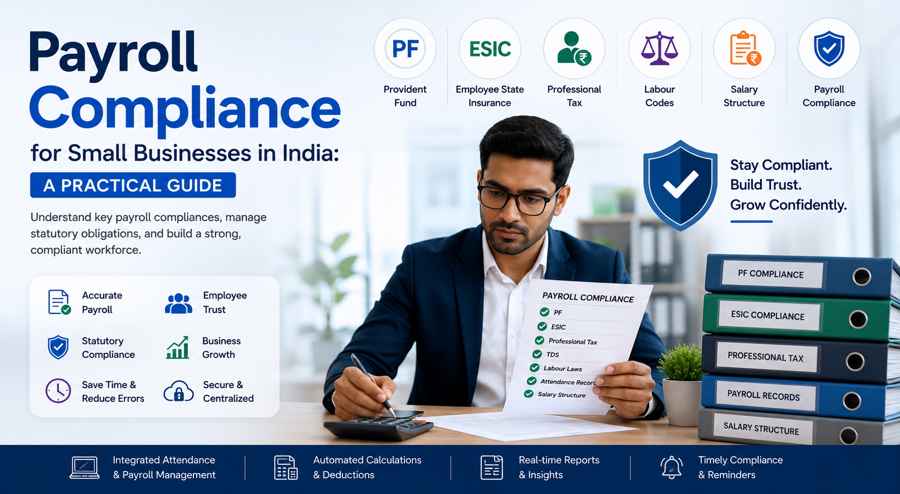
Payroll Compliance for Small Businesses in India: A Practical Guide
Payroll Compliance for Small Businesses in India: A Practical Guide
In Short
Payroll compliance is one of the most important responsibilities for small businesses in India. Beyond salary calculations, employers must manage statutory requirements such as Provident Fund (PF), Employee State Insurance (ESIC), Professional Tax (PT), TDS deductions, salary structures, and labour law obligations. As businesses grow, managing attendance, payroll processing, and compliance through disconnected systems often increases the risk of errors and penalties. Modern attendance and payroll software helps businesses improve payroll accuracy, maintain records, and support compliance management more efficiently.
Payroll Compliance Is More Than Salary Processing
For many small businesses, payroll initially appears simple.
Employees attend work.
Salaries are calculated.
Payments are transferred.
However, as businesses grow and workforce management becomes more structured, payroll responsibilities expand beyond salary calculations.
Businesses may need to consider:
- Provident Fund (PF)
- Employee State Insurance (ESIC)
- Professional Tax (PT)
- Tax Deducted at Source (TDS)
- Leave records
- Attendance records
- Salary structure components
- Employee documentation
- Labour law obligations
This broader responsibility is commonly referred to as payroll compliance.
For growing businesses, payroll compliance is not simply a legal requirement. It is an important part of building operational reliability and employee trust.
What Is Payroll Compliance?
Payroll compliance refers to the process of ensuring that employee salaries, deductions, benefits, and statutory obligations are managed according to applicable regulations and business policies.
Payroll compliance generally involves:
- Maintaining accurate employee records
- Calculating salaries correctly
- Managing statutory deductions
- Recording attendance accurately
- Maintaining payroll documentation
- Following applicable labour regulations
As workforce size increases, payroll compliance becomes increasingly important.
Why Payroll Compliance Matters for Small Businesses
Many small businesses focus heavily on sales, operations, and customer growth.
Payroll compliance often receives attention only after problems appear.
Common issues include:
- Incorrect salary calculations
- Missed statutory deductions
- Incomplete employee records
- Payroll disputes
- Attendance-related payroll errors
- Administrative confusion
These issues can create operational disruptions and reduce employee confidence.
Businesses that establish proper payroll processes early often find workforce management much easier as they grow.
The Connection Between Attendance and Payroll Compliance
One of the most overlooked aspects of payroll compliance is attendance accuracy.
Payroll calculations often depend on:
- Working days
- Leave records
- Overtime hours
- Shift attendance
- Employee availability
When attendance records are inaccurate, payroll calculations may also become inaccurate.
This is why many growing businesses now use integrated attendance and payroll software rather than maintaining separate systems.
👉 Read More : Attendance and Payroll Software: A Practical Guide for Growing Businesses in India
👉Detailed Guide: How Small Businesses Can Save Time and Reduce Payroll Errors with Attendance and Payroll Software
Understanding Provident Fund (PF)
Provident Fund is one of the most recognized payroll-related obligations in India.
PF is designed to help employees build long-term retirement savings through contributions made by both employees and employers.
For businesses, PF management generally involves:
- Employee enrollment where applicable
- Contribution tracking
- Payroll integration
- Record maintenance
As workforce size increases, manual PF management becomes more difficult.
This is one reason businesses often seek structured payroll systems.
Understanding ESIC
Employee State Insurance (ESIC) is a social security and health insurance framework that provides benefits to eligible employees.
For employers, ESIC management may involve:
- Employee registration
- Contribution management
- Payroll deductions
- Record maintenance
As employee count grows, maintaining accurate records becomes increasingly important.
Understanding Professional Tax (PT)
Professional Tax is a state-level tax applicable in certain states.
Requirements vary depending on location and regulations.
Businesses operating across multiple locations often need to understand how Professional Tax applies to their workforce.
Managing payroll centrally helps reduce administrative complexity when handling location-specific obligations.
Why Salary Structure Matters
Many businesses view salary structure only as a payroll document.
In reality, salary structure influences:
- Payroll calculations
- Employee benefits
- Statutory deductions
- Compensation transparency
A well-designed salary structure helps businesses maintain consistency and reduce confusion.
Typical salary structures may include:
- Basic salary
- Allowances
- Incentives
- Deductions
- Statutory components
As organizations grow, structured payroll management becomes increasingly important.
Labour Codes and Workforce Management
Labour regulations continue evolving as workforce management becomes more structured.
While businesses should always seek professional compliance guidance when necessary, maintaining organized employee records remains essential.
Key workforce records often include:
- Attendance history
- Leave records
- Salary information
- Employee documentation
- Payroll records
Businesses that maintain accurate records are generally better prepared for operational and compliance requirements.
Common Payroll Compliance Challenges Faced by Small Businesses
Many growing businesses experience similar challenges:
Attendance Errors
Incorrect attendance records affecting payroll calculations.
Manual Payroll Processing
Spreadsheet-based calculations increasing administrative workload.
Disconnected Systems
Attendance, leave management, and payroll maintained separately.
Employee Record Management
Difficulty maintaining organized employee information.
Growth-Related Complexity
Payroll becoming harder to manage as employee count increases.
These challenges often appear gradually rather than immediately.
👉 Learn More: How a correct software may help you managing attendance and payroll system
Why Businesses Are Moving Toward Integrated Systems
Businesses increasingly prefer centralized workforce management systems because they simplify:
- Attendance tracking
- Payroll processing
- Leave management
- Employee records
- Reporting
Rather than maintaining multiple disconnected tools, organizations can manage workforce operations from one platform.
This improves visibility and reduces administrative effort.
Payroll Compliance Across Different Industries
Different industries face different workforce management requirements.
Offices and Corporate Businesses
Employee attendance, leave tracking, and salary management.
Retail Businesses and Showrooms
Shift scheduling and workforce coordination.
Hospitals and Healthcare Organizations
Complex staffing patterns and shift management.
Factories and Manufacturing Units
Overtime tracking and workforce scheduling.
Construction and Labour Workforce
Field attendance visibility and site-based workforce management.
Schools and Educational Institutions
Teaching and administrative workforce management.
As businesses become more operationally mature, payroll compliance requirements often become more structured as well.
👉 More sources:
1. Read more for attendance and payroll solution for retail businesses and showrooms
2. Detailed guide on attendance and payroll software for Offices and Corporate Businesses
3. How Factories Can Simplify Employee Attendance and Payroll Without Disrupting Production
How Technology Supports Payroll Compliance
Technology does not replace compliance responsibilities.
However, it can help businesses:
- Maintain attendance records
- Improve payroll accuracy
- Centralize employee information
- Simplify workforce reporting
- Reduce administrative effort
For growing businesses, reliable record management often becomes one of the most valuable operational benefits.
How Presentrak Helps Growing Businesses
Presentrak helps businesses manage:
- Attendance tracking
- Payroll processing
- Leave management
- Employee records
- GPS attendance
- Face recognition attendance
through a centralized platform designed for Indian businesses.
As workforce complexity increases, businesses need systems that improve visibility, accuracy, and operational consistency.
👉 Detailed article: Attendance and Payroll Software.
👉 Attendance and payroll software pricing.
Conclusion
Payroll compliance is not only about salary processing.
It involves attendance accuracy, employee records, statutory obligations, salary structures, and workforce management practices that help businesses operate more effectively.
As businesses grow, maintaining compliance through manual processes often becomes increasingly difficult.
A structured approach to attendance, payroll, and employee management helps businesses build stronger operational foundations while improving workforce transparency and reliability.
Frequently Asked Questions
What is payroll compliance?
Payroll compliance refers to managing employee salaries, deductions, records, and payroll-related obligations according to applicable regulations and business requirements.
Why is attendance important for payroll compliance?
Attendance records directly affect salary calculations, leave adjustments, overtime management, and payroll accuracy.
What is PF in payroll?
Provident Fund (PF) is a retirement savings mechanism involving contributions from employees and employers where applicable.
What is ESIC?
ESIC is a social security and health insurance framework that provides benefits to eligible employees.
What is Professional Tax?
Professional Tax is a state-level tax applicable in certain Indian states and may affect payroll processing requirements.
How can payroll software help with compliance?
Payroll software helps businesses maintain records, improve payroll accuracy, manage attendance information, and simplify workforce administration.
Why do growing businesses need payroll compliance systems?
As workforce size increases, manual processes often become difficult to manage consistently. Structured systems help improve operational accuracy and record management.
Can Presentrak help businesses manage PF, ESIC, and payroll records more efficiently?
Presentrak helps businesses centralize attendance tracking, payroll processing, leave management, and employee records in one platform. Accurate workforce records can support payroll administration and help businesses maintain organized information related to PF, ESIC, Professional Tax, and other payroll compliance processes. Read More on payroll compliance for small businesses in India.