
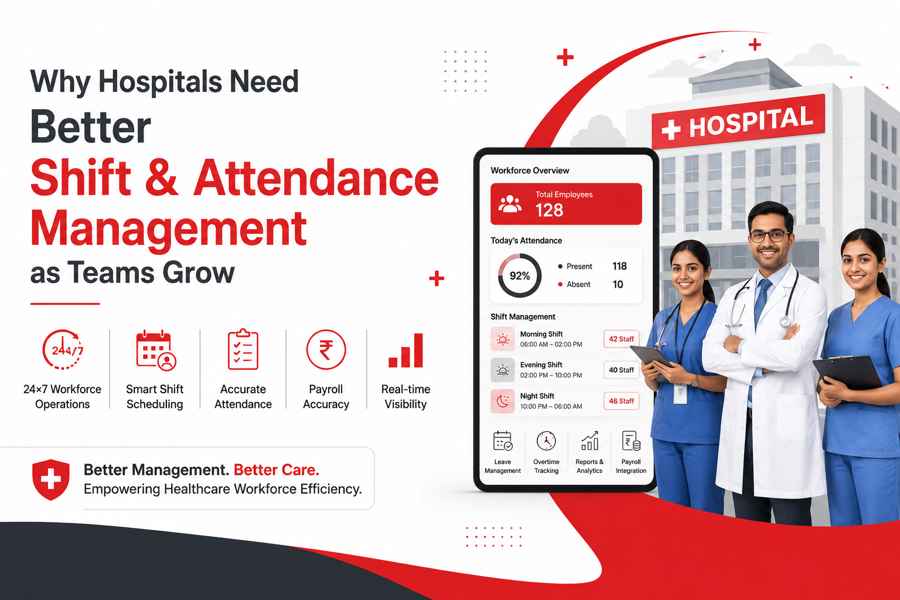
Why Hospitals Need Better Shift & Attendance Management as Teams Grow
Why Hospitals Need Better Shift & Attendance Management as Teams Grow
In Short
Hospitals and healthcare organizations operate around the clock, making workforce management more complex than many other industries. As teams grow, managing shifts, attendance, leaves, overtime, and payroll manually becomes increasingly difficult. Modern attendance and payroll systems help healthcare organizations improve accuracy, maintain continuity of care, and simplify workforce operations.
Healthcare Operations Never Stop
Unlike traditional office businesses, hospitals function 24×7.
Doctors, nurses, technicians, administrative staff, pharmacists, housekeeping teams, and support personnel work in different shifts to ensure uninterrupted patient care.
When the workforce is small, attendance and shift management may be manageable through spreadsheets or manual processes. However, as hospitals expand, workforce complexity increases significantly.
Managing hundreds of employees across multiple shifts requires better systems and greater visibility.
Why Shift Management Is Critical in Hospitals
Healthcare organizations depend heavily on shift-based operations.
Staff may work:
- Morning shifts.
- Evening shifts.
- Night shifts.
- Emergency duty rotations.
- Weekly offs.
- On-call schedules.
Managing these schedules manually becomes challenging as teams grow.
Small mistakes can create staffing shortages and increase administrative workload.
Common Challenges Hospitals Face With Manual Attendance Management
Multiple Shifts Increase Complexity
Hospitals often have employees working different schedules every day.
Manual tracking creates problems such as:
- Incorrect attendance entries.
- Shift confusion.
- Overtime calculation errors.
- Payroll discrepancies.
- Time-consuming reconciliation.
Leave Management Becomes Difficult
Healthcare organizations constantly manage:
- Casual leaves.
- Sick leaves.
- Emergency leaves.
- Shift replacements.
Without centralized records, coordinating employee availability becomes more difficult.
Payroll Accuracy Depends on Attendance
Healthcare payroll calculations frequently include:
- Working hours.
- Night shift allowances.
- Overtime.
- Weekly offs.
- Leave adjustments.
When attendance records are maintained manually, payroll preparation becomes more complicated and errors become more common.
Limited Workforce Visibility
Managers often need answers to questions like:
- Which nurses are currently on duty?
- Who is on leave?
- Which shift is understaffed?
- How many employees are present today?
Searching through spreadsheets or attendance registers consumes valuable time.
Why Hospitals Are Moving Towards Digital Workforce Management
Modern healthcare organizations need systems that help manage:
- Attendance records.
- Shift scheduling.
- Leave management.
- Payroll preparation.
- Working hours.
- Employee reports.
- Multi-department workforce operations.
Centralized attendance systems improve operational visibility and reduce administrative burden.
Better Shift Planning Improves Patient Care
Workforce planning directly impacts healthcare operations.
Proper attendance management helps hospitals:
- Avoid staff shortages.
- Improve shift coordination.
- Reduce scheduling conflicts.
- Maintain operational continuity.
- Improve employee accountability.
Efficient workforce management allows medical teams to focus more on patient care instead of administrative tasks.
Growing Healthcare Organizations Need Scalable Systems
As hospitals expand, they often add:
- New departments.
- Additional clinics.
- Diagnostic centers.
- Satellite branches.
Managing attendance separately for each location becomes difficult.
Centralized attendance and payroll systems help organizations maintain consistency across multiple facilities.
Attendance and Payroll Work Better Together
Attendance records influence:
- Salary calculations.
- Overtime payments.
- Shift allowances.
- Leave deductions.
- Payroll reports.
Managing these functions together reduces duplicate work and improves payroll accuracy.
Why Healthcare Workforce Management Is About Reliability
Healthcare operations depend on people.
Reliable workforce management helps organizations:
- Maintain adequate staffing.
- Improve attendance accuracy.
- Reduce payroll errors.
- Enhance operational efficiency.
- Support long-term growth.
Modern attendance and payroll solutions for hospitals and healthcare organizations provide the visibility required to manage healthcare teams more effectively.
Conclusion
As hospitals and healthcare organizations grow, manual attendance and shift management processes become increasingly difficult to maintain.
Digital attendance and payroll systems help healthcare organizations simplify shift management, improve payroll accuracy, and maintain workforce visibility while supporting uninterrupted patient care.
Related Resource
Explore Presentrak's Attendance & Payroll Software solutions designed for growing businesses and different industries.
FAQs
1. Why is shift management important for hospitals?
Hospitals operate 24×7, requiring doctors, nurses, technicians, and support staff to work in multiple shifts. Effective shift management helps maintain adequate staffing and improve operational continuity.
2. What challenges do hospitals face with manual attendance management?
Manual systems often lead to attendance errors, shift confusion, overtime calculation issues, payroll discrepancies, and increased administrative workload.
3. Can attendance software help hospitals manage multiple shifts?
Yes. Modern attendance systems help healthcare organizations manage morning, evening, night, and rotating shifts while maintaining accurate attendance records.
4. Why is payroll linked to attendance management in hospitals?
Attendance records influence working hours, overtime payments, leave deductions, and shift allowances. Integrated systems help improve payroll accuracy.
5. Is attendance and payroll software suitable for healthcare organizations?
Yes. Hospitals, clinics, diagnostic centers, and healthcare organizations can use attendance and payroll software to simplify workforce operations and improve efficiency.