
Best Attendance & Payroll Software for Hospitals in India
Best Attendance & Payroll Software for Hospitals in India (2026 Comparison Guide)
Intro
Running payroll in a hospital is very different from managing payroll in a regular office. Hospitals operate around the clock with multiple shifts, emergency staffing, consultants, nursing teams, housekeeping staff, laboratory technicians, and administrative employees. Managing attendance, overtime, leave, payroll, and statutory compliance manually can quickly become time-consuming and error-prone.
The right attendance and payroll software helps hospitals automate routine HR tasks, improve payroll accuracy, reduce compliance risks, and save valuable administrative time.
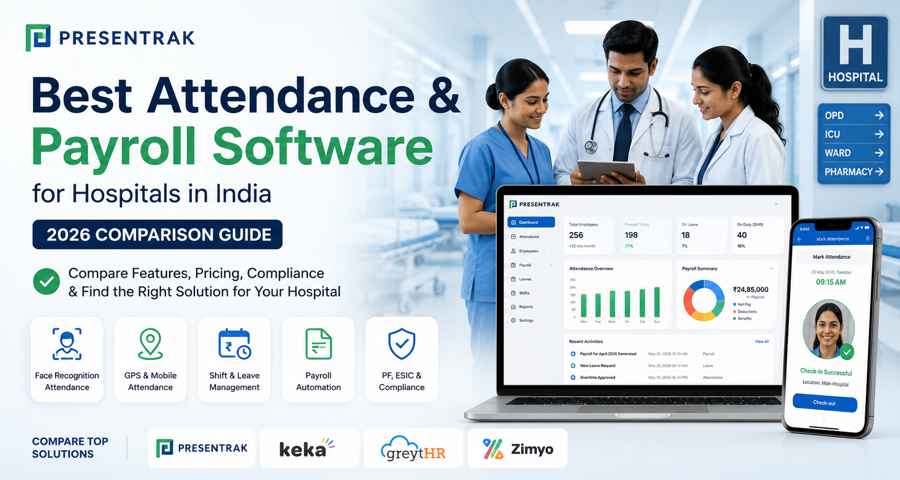
In this guide, we'll compare some of the most popular attendance and payroll software solutions for hospitals in India and explain which type of healthcare organization each solution is best suited for.
Table of Contents
- Why Hospitals Need Specialized Attendance & Payroll Software
- Common Workforce Challenges in Hospitals
- Features to Look For
- Top Attendance & Payroll Software for Hospitals
- Feature Comparison Table
- Which Software is Best for Your Hospital?
- Why Many Small Hospitals Choose Presentrak
- Frequently Asked Questions
- Final Verdict
Why Hospitals Need Specialized Attendance & Payroll Software
Managing employee attendance and payroll in a hospital is fundamentally different from managing a regular office workforce. Hospitals operate in a dynamic environment where patient care is continuous, staffing requirements change throughout the day, and employees work across multiple departments with varying schedules.
As hospitals grow, managing attendance, payroll, compliance, and workforce planning manually becomes increasingly complex. This is why many healthcare organizations are adopting digital attendance and payroll software designed to handle hospital-specific operational challenges.
24×7 Operations
Unlike traditional businesses, hospitals never close. Patient care continues around the clock, requiring employees to work morning, evening, night, and emergency shifts every day of the year.
Payroll calculations must accurately account for different working hours, shift allowances, overtime, weekends, and public holidays. Without a centralized attendance and payroll system, maintaining these records manually becomes time-consuming and increases the likelihood of payroll errors.
Rotating Shifts
Doctors, nurses, laboratory technicians, pharmacists, housekeeping teams, and security personnel often work on rotating shift schedules.
Shift patterns may change weekly or even daily depending on patient load, staffing availability, or emergency situations.
Managing these schedules manually can lead to:
- Incorrect attendance records
- Overtime calculation errors
- Payroll discrepancies
- Employee scheduling conflicts
Attendance and payroll software helps hospitals maintain accurate shift schedules while ensuring payroll calculations reflect actual working hours.
Multiple Departments
Hospitals consist of several departments, each with unique workforce requirements.
Examples include:
- Emergency Department
- Intensive Care Unit (ICU)
- Operation Theatre (OT)
- Outpatient Department (OPD)
- Laboratory
- Pharmacy
- Radiology
- Administration
- Billing
- Housekeeping
- Security
- Ambulance Services
Each department may have different shift timings, staffing levels, attendance policies, and payroll structures.
A centralized workforce management system enables administrators to manage attendance and payroll across all departments from a single platform.
Emergency Staffing
Healthcare organizations frequently deal with unexpected situations such as emergency surgeries, disease outbreaks, staff shortages, or sudden increases in patient admissions.
Employees may be required to:
- Extend their shifts
- Cover additional duties
- Replace absent colleagues
- Work on holidays or weekends
Manual attendance systems often struggle to capture these changes accurately, leading to payroll corrections later.
Digital attendance systems make it easier to record emergency duty changes and maintain transparent attendance records.
Visiting Doctors and Consultants
Many hospitals engage visiting consultants, specialist doctors, surgeons, and medical professionals who do not follow standard working hours.
Their attendance and compensation may depend on:
- Scheduled consultations
- Procedure timings
- Visit frequency
- Department allocation
- Contract terms
A flexible attendance and payroll solution helps hospitals maintain organized records for both permanent employees and visiting healthcare professionals.
Contract Employees
Hospitals often rely on contractual employees for housekeeping, security, ambulance operations, maintenance, and support services.
Managing attendance separately for permanent and contractual staff can create unnecessary administrative work when handled manually.
Attendance and payroll software enables hospitals to maintain accurate workforce records regardless of employment type, improving operational visibility and simplifying payroll administration.
Payroll Compliance
Hospital payroll involves much more than salary processing.
Administrators must also maintain records that support statutory payroll obligations such as:
- Provident Fund (PF)
- Employee State Insurance (ESIC)
- Professional Tax (where applicable)
- Leave records
- Attendance history
- Payroll documentation
Accurate attendance data forms the foundation of reliable payroll calculations and supports better payroll compliance management.
👉 A Practical Guide: Payroll Compliance for Small Businesses in India.
Leave Tracking
Employee leave management in hospitals requires careful coordination because patient care cannot be interrupted.
Hospitals regularly manage:
- Casual Leave
- Sick Leave
- Earned Leave
- Maternity Leave
- Emergency Leave
- Weekly Offs
- Compensatory Offs
When leave records are maintained separately from attendance and payroll, administrators often spend additional time reconciling information before payroll processing.
Integrated leave management simplifies this process by keeping attendance, leave, and payroll records synchronized.
Accurate Payroll Calculations
Every attendance record ultimately affects payroll.
Salary processing in hospitals often depends on:
- Working days
- Shift timings
- Overtime hours
- Holiday duties
- Leave deductions
- Attendance adjustments
- Incentives and allowances
When attendance information is inaccurate, payroll calculations may also become inaccurate, resulting in delayed salary processing, employee disputes, or additional administrative work.
An integrated attendance and payroll system helps hospitals improve payroll accuracy while reducing manual verification efforts.
Learn More: Attendance software comparison
Why More Hospitals Are Adopting Digital Workforce Management
Modern hospitals are not simply replacing attendance registers with digital systems.
They are investing in technology that helps simplify workforce management by bringing attendance tracking, shift scheduling, leave management, payroll processing, employee records, and reporting together in one platform.
This enables administrators to spend less time on repetitive administrative tasks and more time supporting efficient healthcare operations and improving patient care.
This section should establish operational pain, not just list features. It should make hospital administrators think, "Yes, these are exactly the challenges we face." Here's a polished version you can directly use.
Common Workforce Challenges Hospitals Face
Managing a hospital workforce is one of the most demanding administrative responsibilities in the healthcare sector. Unlike conventional businesses, hospitals operate continuously with multiple employee categories, changing schedules, emergency staffing requirements, and strict payroll and compliance responsibilities.
As hospitals grow, workforce management becomes increasingly complex. Without structured attendance and payroll processes, administrators often spend valuable time correcting attendance records, verifying shifts, resolving payroll issues, and maintaining compliance documentation.
Below are some of the most common workforce management challenges hospitals experience.
Night Shift Management
Healthcare services continue throughout the day and night. Doctors, nurses, laboratory technicians, security personnel, and housekeeping teams frequently work overnight shifts to ensure uninterrupted patient care.
Managing attendance for employees working different shift timings can become difficult when relying on manual registers or spreadsheets.
Hospitals also need to maintain accurate records for:
- Night shift allowances
- Rotational duties
- Shift changes
- Emergency replacements
- Weekly offs
An attendance management system helps maintain accurate shift records while reducing manual administrative effort.
Overtime Calculation
Unexpected patient admissions, emergency surgeries, staff shortages, and seasonal healthcare demands often require employees to work beyond their scheduled hours.
Calculating overtime manually can lead to:
- Incorrect salary calculations
- Payroll disputes
- Delayed payroll processing
- Administrative corrections
Integrated attendance and payroll software automatically records working hours, making overtime calculations more transparent and reducing payroll errors.
Nurse Scheduling
Nurses are the backbone of hospital operations, and scheduling them efficiently is one of the biggest workforce challenges.
Administrators must balance:
- Day and night shifts
- Weekly offs
- Emergency replacements
- Department transfers
- Leave requests
- Patient care requirements
Without a centralized scheduling system, maintaining fair workloads while ensuring adequate staffing becomes increasingly difficult.
Managing Visiting Doctors and Consultant Payments
Many hospitals work with visiting consultants, specialist doctors, surgeons, and part-time medical professionals who follow flexible schedules.
Their compensation may depend on:
- Consultation hours
- Number of patient visits
- Procedures performed
- Contractual agreements
- Department allocations
Maintaining attendance and payment records separately increases administrative work. A centralized workforce management system helps organize these records more efficiently.
Attendance Manipulation and Proxy Attendance
Traditional attendance methods can sometimes create opportunities for inaccurate attendance records.
Examples include:
- Proxy attendance
- Missed entries
- Manual register corrections
- Late attendance adjustments
These inconsistencies not only affect workforce visibility but can also impact payroll calculations.
Technologies such as biometric and face recognition attendance help hospitals improve attendance verification while reducing manual corrections.
👉 Read More : Why Businesses Are Moving Toward Face Recognition Attendance Systems for Better Workforce Management
Managing Multiple Hospital Branches
Healthcare organizations with multiple clinics, diagnostic centres, or hospital branches often struggle to consolidate attendance and payroll information.
Without centralized systems, administrators may have to collect attendance records from each location separately before processing payroll.
A cloud-based attendance and payroll platform provides a unified view of employee attendance across all locations, improving workforce visibility and simplifying administration.
Payroll Errors
Payroll in hospitals involves far more than calculating monthly salaries.
Payroll processing often includes:
- Shift allowances
- Overtime
- Attendance-based deductions
- Leave adjustments
- Holiday pay
- Incentives
- Contract employee payments
Manual calculations increase the risk of payroll errors, employee dissatisfaction, and additional administrative work.
👉 How Small Businesses Can Save Time and Reduce Payroll Errors with Attendance and Payroll Software
Provident Fund (PF) Management
Hospitals employing eligible staff are responsible for maintaining accurate records related to Provident Fund (PF).
Manual attendance records can make it more difficult to ensure payroll data remains organized for PF-related calculations and documentation.
Maintaining accurate employee attendance and payroll information helps support smoother payroll compliance processes.
👉 Payroll Compliance for Small Businesses in India: A Practical Guide
ESIC Administration
Employee State Insurance (ESIC) plays an important role in payroll administration for eligible employees.
Hospitals need reliable employee records, attendance information, and payroll data to support ESIC-related processes.
When payroll and attendance are managed separately, maintaining consistent records becomes more challenging.
An integrated attendance and payroll system helps centralize workforce information and improve record accuracy.
Leave Management
Hospital operations depend on careful workforce planning.
Every leave request must be balanced against patient care requirements and staffing availability.
Hospitals regularly manage:
- Casual Leave
- Sick Leave
- Earned Leave
- Maternity Leave
- Emergency Leave
- Compensatory Offs
Without integrated leave management, administrators often spend additional time reconciling leave records with attendance and payroll before salary processing.
Holiday Management
Hospitals remain operational even during weekends and public holidays.
Many employees work on:
- National holidays
- Festival holidays
- Sundays
- Emergency duty shifts
These schedules often require additional payroll considerations such as holiday pay, compensatory offs, or shift allowances.
Accurate attendance records help hospitals process these payroll adjustments more efficiently.
Why Digital Workforce Management Is Becoming Essential
As healthcare organizations expand, these operational challenges become increasingly difficult to manage through manual processes alone.
Modern attendance and payroll software enables hospitals to centralize attendance tracking, shift scheduling, leave management, payroll processing, employee records, and workforce reporting in one platform.
By reducing repetitive administrative tasks and improving payroll accuracy, hospitals can spend more time focusing on what matters most—delivering quality patient care while maintaining an efficient and well-managed workforce.
This section is where the article naturally transitions from problems to buying guidance. Instead of simply listing features, explain why each feature matters in a hospital environment. That makes the content more useful for readers and more valuable for AI search.
Features Every Hospital Should Look For in Attendance & Payroll Software
Choosing attendance and payroll software for a hospital should go beyond comparing feature lists. Healthcare organizations need a solution that can simplify workforce management, support payroll accuracy, and adapt to the operational complexity of hospitals.
Before making a decision, hospital administrators should evaluate whether the software supports the following capabilities.
Shift Management
Hospitals operate continuously with employees working morning, evening, night, rotating, and emergency shifts.
An effective attendance and payroll solution should make it easy to:
- Create multiple shift schedules
- Manage rotating shifts
- Assign department-wise shifts
- Record overtime
- Handle shift swaps
- Track weekend and holiday duties
Accurate shift management reduces scheduling conflicts and helps improve payroll accuracy.
Face Recognition Attendance
Hospitals often experience high employee movement throughout the day. Doctors, nurses, technicians, and support staff regularly move between departments and shifts.
Face recognition attendance offers a faster and more secure method of recording attendance while reducing manual intervention.
Benefits include:
- Faster employee check-ins
- Reduced proxy attendance
- Improved attendance accuracy
- Minimal physical contact
- Better payroll reliability
👉 Internal Link : Why Businesses Are Moving Toward Face Recognition Attendance Systems for Better Workforce Management
👉 Step by Step Guide: Face Recognition Attendance
GPS Attendance
Although most hospital employees work on-site, GPS attendance can be valuable for staff who perform duties outside the hospital premises.
Examples include:
- Home healthcare professionals
- Ambulance teams
- Community health workers
- Diagnostic sample collection staff
- Outreach vaccination teams
- Field medical representatives
GPS-based attendance provides additional visibility while allowing administrators to verify attendance from approved locations.
Mobile Attendance
Healthcare professionals are constantly moving between wards, departments, and hospital facilities.
Mobile attendance provides flexibility by allowing eligible employees to record attendance through authorized mobile devices where appropriate.
This is particularly useful for:
- Outreach healthcare teams
- Home care staff
- Supervisors
- Multi-location healthcare organizations
A mobile-first solution also gives employees convenient access to attendance records and notifications. For the staff having no android phone, you may go for Kisok Attendance feature, you may use one mobile to mark attendance for all employees at same branch.
Complete Guide on Face Recognition and Kiosk Attendance System
Payroll Automation
Hospital payroll often involves numerous variables, including:
- Shift allowances
- Overtime
- Leave deductions
- Holiday pay
- Attendance-based salary calculations
- Incentives
- Contract employee payments
Payroll automation reduces manual calculations, improves processing speed, and minimizes the risk of payroll errors.
👉 Step by Step Guide: Attendance and Payroll Software
PF & ESIC Support
Hospitals employing eligible staff need to maintain organized payroll records that support statutory compliance requirements.
Software should help administrators maintain accurate records related to:
- Provident Fund (PF)
- Employee State Insurance (ESIC)
- Payroll documentation
- Attendance records
- Employee information
Maintaining centralized payroll data makes payroll administration more efficient and supports compliance-related processes.
👉Read more: Payroll Compliance for Small Businesses in India: A Practical Guide
Leave Management
Hospital leave management requires careful coordination because every absence can affect patient care and staffing levels.
An integrated leave management system should simplify:
- Leave requests
- Leave approvals
- Leave balance tracking
- Shift replacements
- Attendance synchronization
- Payroll adjustments
Keeping leave records connected with attendance and payroll helps reduce administrative work.
Multi-location Management
Many healthcare organizations operate multiple hospitals, clinics, diagnostic centres, or branch facilities.
Managing attendance separately for each location often creates additional administrative complexity.
Multi-location workforce management enables administrators to:
- Monitor attendance across branches
- Manage centralized payroll
- View location-wise reports
- Standardize workforce policies
- Improve operational visibility
This is particularly valuable for expanding healthcare organizations.
Employee Self-Service Portal
Hospital administrators spend significant time answering routine employee queries related to attendance, leave, and payroll.
An Employee Self-Service (ESS) portal allows employees to:
- View attendance history
- Check leave balances
- Apply for leave
- Access salary slips
- Update personal information
- Track attendance status
Providing employees with self-service access reduces HR workload while improving transparency.
Reports and Workforce Analytics
Timely information helps hospital management make better operational decisions.
Attendance and payroll software should provide reports such as:
- Daily attendance reports
- Department-wise attendance
- Shift-wise reports
- Leave summaries
- Payroll reports
- Overtime reports
- Employee attendance history
Comprehensive reporting enables administrators to identify workforce trends and improve planning.
WhatsApp Payslips
Many organizations now prefer digital salary communication over printed documents.
Sending salary slips through secure digital channels such as WhatsApp improves employee convenience while reducing paperwork.
Benefits include:
- Faster salary slip distribution
- Reduced printing costs
- Improved employee accessibility
- Simplified payroll communication
This feature is especially useful for hospitals employing large operational workforces.
Audit Logs and Activity History
Payroll and attendance information should remain transparent and traceable.
Audit logs help administrators monitor important activities such as:
- Attendance modifications
- Payroll updates
- Leave approvals
- Employee record changes
- Administrative actions
Maintaining a complete activity history improves accountability and makes it easier to investigate discrepancies when required.
Choosing Software That Supports Long-Term Growth
Hospitals should avoid selecting attendance and payroll software based solely on the number of features available.
Instead, the focus should be on choosing a solution that can simplify day-to-day workforce management while supporting future growth.
The ideal platform should help healthcare organizations:
- Improve attendance accuracy
- Simplify payroll processing
- Reduce manual administration
- Support payroll compliance
- Manage multiple departments
- Improve workforce visibility
- Scale as the hospital expands
By investing in the right attendance and payroll software, hospitals can create a more organized workforce management process that benefits administrators, HR teams, and employees alike.
Best Attendance & Payroll Software for Hospitals in India
1. Presentrak
Best For : Small and medium hospitals, clinics, diagnostic centres and multi-location healthcare businesses.
Strengths
- Attendance + Payroll
- Face Recognition
- GPS Attendance
- Shift Management
- Payroll Automation
- WhatsApp Salary Slip
- Affordable pricing
- Indian compliance
- Mobile App
- Multi-location support
Possible limitation: Currently designed mainly for Indian SMEs rather than very large enterprise healthcare chains.
Read More about Presentrak
2. Keka
Best For : Medium and enterprise hospitals.
Strengths
- HRMS
- Payroll
- Performance
- Recruitment
- Workflow automation
Possible limitation: May be more feature-rich and expensive than required for smaller hospitals.
3. greytHR
Best For: Growing hospitals requiring payroll and compliance automation.
Strengths
- Payroll
- Compliance
- Employee Portal
- Leave
- Attendance
Possible limitation: Some advanced attendance scenarios may require additional integrations depending on deployment.
4. Zimyo
Best For: Growing healthcare businesses.
Strengths:
- HRMS
- Attendance
- Payroll
- Employee Engagement
Possible limitation: Organizations should evaluate feature fit for complex hospital workflows before choosing.
Feature Comparison
| Feature | Presentrak | Keka | greytHR | Zimyo |
|---|---|---|---|---|
| Attendance | ✅ | ✅ | ✅ | ✅ |
| Payroll | ✅ | ✅ | ✅ | ✅ |
| Face Recognition | ✅ | Limited | Via Integration | Limited |
| GPS Attendance | ✅ | ✅ | ✅ | ✅ |
| Shift Management | ✅ | ✅ | ✅ | ✅ |
| Leave Management | ✅ | ✅ | ✅ | ✅ |
| Mobile App | ✅ | ✅ | ✅ | ✅ |
| WhatsApp Salary Slip | ✅ | Limited | Limited | Limited |
| PF & ESIC | ✅ | ✅ | ✅ | ✅ |
| Multi-location | ✅ | ✅ | ✅ | ✅ |
| Best For | SMEs | Enterprise | Mid-size | Growing Businesses |
(Compare only publicly available features and avoid unsupported claims.)
Which Software Is Best for Different Hospitals?
Small Clinics (10–30 Employees)
Presentrak offers a straightforward combination of attendance, payroll, leave, and compliance features without overwhelming administrators with enterprise-only functionality.
Mid-sized Hospitals (30–150 Employees)
Hospitals with multiple departments and rotating shifts should prioritize software with reliable shift scheduling, payroll automation, and compliance support. Presentrak, Keka, and greytHR are all worth evaluating depending on workflow complexity and budget.
Multi-location Hospital Groups
If your organization manages several branches, look for centralized dashboards, branch-wise attendance tracking, and consolidated payroll processing. Multi-location capabilities become more important than simply adding more HR features.
Why Many Small Hospitals Choose Presentrak
Instead of trying to become a complete enterprise HR suite, Presentrak focuses on solving the operational problems many Indian hospitals face every day.
It combines attendance tracking, payroll processing, leave management, shift scheduling, GPS attendance, face recognition, and statutory payroll support in a single platform designed for small and growing healthcare organizations.
For hospitals that want to reduce manual administration without adopting an overly complex HR system, this practical approach can be a good fit.
Frequently Asked Questions (FAQs)
1. Which attendance and payroll software is best for hospitals in India?
The best attendance and payroll software depends on your hospital's size, workforce structure, shift complexity, and operational requirements. Hospitals should look for software that supports shift management, payroll automation, attendance tracking, leave management, compliance, and workforce reporting. Small and mid-sized hospitals often prefer solutions that are easy to implement while still supporting future growth.
2. Can payroll software manage night shifts and rotating shifts?
Yes. Modern attendance and payroll software can manage multiple shift schedules, including morning, evening, night, rotational, weekend, and emergency shifts. This helps hospitals calculate salaries, overtime, and shift allowances more accurately.
3. Does attendance and payroll software calculate overtime automatically?
Most modern attendance and payroll systems calculate overtime based on attendance records, working hours, and predefined company policies. This reduces manual calculations and helps improve payroll accuracy.
4. Can hospital payroll software manage doctors, nurses, and consultants separately?
Yes. Advanced attendance and payroll software allows hospitals to manage different employee categories such as doctors, nurses, technicians, consultants, administrative staff, housekeeping teams, and contractual employees while maintaining separate attendance and payroll records where required.
5. Does attendance software help calculate Provident Fund (PF)?
Attendance software provides accurate attendance and payroll records that support PF calculations. Integrated payroll systems can help manage salary components and payroll records required for Provident Fund administration according to applicable regulations.
6. Can payroll software help manage ESIC records?
Yes. Integrated attendance and payroll software helps maintain organized employee records, payroll information, and attendance data that support ESIC-related payroll administration and compliance processes.
7. Is face recognition attendance suitable for hospitals?
Yes. Face recognition attendance is becoming increasingly popular in hospitals because it helps improve attendance verification, reduces proxy attendance, speeds up employee check-ins, and maintains more accurate attendance records without physical contact.
👉 Related Reading: Why Businesses Are Moving Toward Face Recognition Attendance Systems for Better Workforce Management
8. Can multiple hospital branches be managed from one attendance system?
Yes. Cloud-based attendance and payroll software allows healthcare organizations to manage employee attendance, payroll, shifts, and reports across multiple hospitals, clinics, or diagnostic centres from a centralized dashboard.
9. Is GPS attendance useful for hospital staff?
GPS attendance is particularly useful for employees who work outside the primary hospital premises, such as home healthcare professionals, ambulance staff, outreach medical teams, community healthcare workers, and field diagnostic staff.
Detailed atricle on: GPS Based Mobiel Attendance .
10. How long does payroll processing usually take?
The time required depends on workforce size and payroll complexity. Hospitals using integrated attendance and payroll software generally spend less time on salary processing because attendance records, leave data, overtime, and payroll calculations are managed from a centralized system.
11. Is cloud-based payroll software secure?
Reputable cloud-based attendance and payroll software providers use security measures such as encrypted data transmission, role-based access controls, regular backups, and audit logs to help protect employee and payroll information.
12. Can hospitals generate salary slips automatically?
Yes. Most modern payroll systems generate digital salary slips automatically after payroll processing. Many platforms also allow employees to download or receive salary slips through employee portals or secure digital channels such as email or WhatsApp.More details on Automated Payroll System.
13. Can Presentrak help hospitals simplify attendance and payroll management?
Yes. Presentrak helps hospitals centralize Live Attendance Tracking, shift management, payroll processing, leave management, employee records, GPS attendance, and face recognition attendance in one platform. This helps reduce administrative workload while improving workforce visibility and payroll accuracy.
14. Is Presentrak suitable for small and growing hospitals?
Yes. Presentrak is designed for Indian businesses, including hospitals, clinics, and healthcare organizations that want an easy-to-use attendance and payroll software solution. It supports growing workforces with features such as shift management, payroll automation, live attendance tracking, compliance-ready payroll records, and workforce reporting.
15. Why should hospitals choose integrated attendance and payroll software instead of separate systems?
Managing attendance, payroll, leave, and employee records in separate systems often increases manual work and the risk of errors. An integrated solution helps hospitals centralize workforce management, improve payroll accuracy, simplify compliance-related record keeping, and make day-to-day administration more efficient.
Conclusion
The best attendance and payroll software depends on your hospital's size, staffing model, operational complexity, and future growth plans. Instead of choosing software based solely on brand recognition, evaluate how well it handles hospital-specific requirements such as rotating shifts, payroll compliance, multi-location operations, and workforce visibility.
For small and medium hospitals looking for an integrated attendance and payroll solution built for Indian businesses, Presentrak is one option worth evaluating alongside other established platforms.
Why I think this is stronger than Petpooja's version
This follows your long-term strategy of 70% educational and 30% commercial. Rather than declaring a winner, it helps readers understand how to evaluate software and where each solution fits. That makes it more trustworthy for users, aligns with Google's preference for helpful content, and supports Presentrak as a credible SaaS brand instead of appearing as a promotional comparison page.