
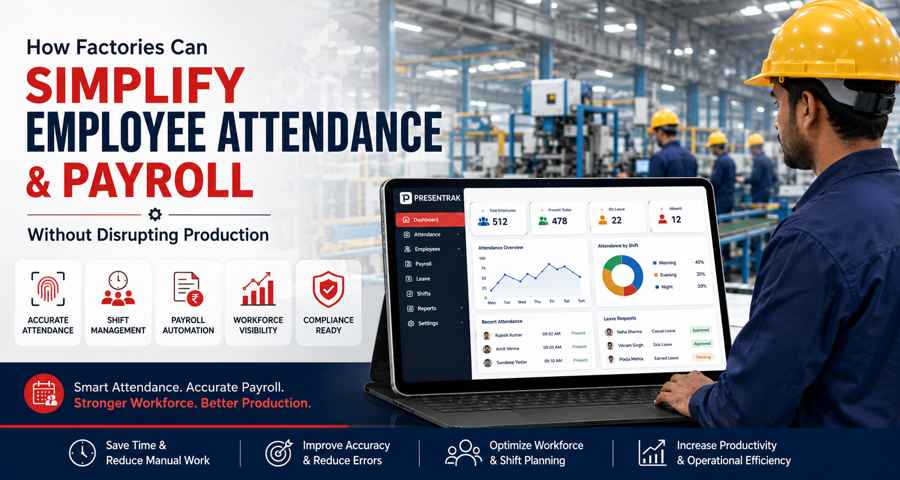
How Factories Can Simplify Employee Attendance and Payroll Without Disrupting Production
How Factories Can Simplify Employee Attendance and Payroll Without Disrupting Production
In Short:
Managing attendance and payroll in a manufacturing environment is far more complex than in a standard office. Factories operate with multiple shifts, production lines, contract workers, overtime, and strict production schedules. Even small attendance errors can affect payroll calculations, manpower planning, and daily production targets.
Modern attendance and payroll software helps factories automate attendance tracking, manage shifts, calculate payroll accurately, monitor workforce productivity, and reduce administrative workload—all without disrupting production. This guide explains the operational challenges manufacturing businesses face and how digital workforce management helps simplify factory operations as businesses grow.
Introduction:
Manufacturing businesses depend on one critical resource every day—people.
Machines, raw materials, and production schedules can only deliver results when the right employees are available at the right time.
Unlike many businesses where attendance primarily affects office administration, factory attendance directly impacts production capacity, workforce planning, delivery schedules, overtime costs, and payroll accuracy.
As manufacturing businesses expand, manual attendance registers and spreadsheet-based payroll systems often struggle to keep pace with increasing workforce complexity.
Managing multiple shifts, contract labour, overtime, leave, and payroll manually not only consumes administrative time but also increases the likelihood of payroll disputes and production delays.
This is why many factories across India are gradually moving toward integrated attendance and payroll software that centralizes workforce management while improving operational efficiency.
👉 Learn more about Attendance and Payroll Software
👉 A Complete Guide on Attendance & Payroll Software for Factories
Why Factory Workforce Management Is Different
Manufacturing businesses operate under conditions that differ significantly from offices, retail stores, or service organizations.
Factories often manage hundreds of employees working simultaneously across multiple production lines, departments, and shifts.
A typical manufacturing workforce may include:
- Production operators
- Machine operators
- Assembly line workers
- Supervisors
- Quality control staff
- Maintenance engineers
- Warehouse employees
- Dispatch teams
- Security personnel
- Housekeeping staff
- Contract labour
- Administrative employees
Each category may follow different attendance rules, shift timings, overtime policies, weekly offs, incentive structures, and payroll calculations.
Unlike office environments where employees usually work fixed hours, factories must continuously balance workforce availability with production targets.
This makes attendance management one of the most important operational functions within a manufacturing business.
Why Attendance Directly Impacts Production
In manufacturing, attendance is more than an HR responsibility.
It influences day-to-day production.
When employees arrive late, miss shifts, or attendance records are inaccurate, factories may experience:
- Production delays
- Machine downtime
- Overtime increases
- Shift shortages
- Supervisor scheduling challenges
- Reduced operational efficiency
Accurate attendance data helps production managers allocate manpower efficiently while allowing HR teams to process payroll more accurately.
This is one of the main reasons manufacturing companies increasingly invest in dedicated attendance and payroll systems instead of relying solely on manual records.
Common Attendance Challenges Manufacturing Businesses Face
As factories grow, attendance management becomes increasingly difficult.
Some of the most common operational challenges include:
Multiple Shift Operations
Factories often operate across:
- Morning shifts
- Evening shifts
- Night shifts
- Rotational shifts
- Weekend production
- Holiday production
Managing these schedules manually becomes increasingly difficult as workforce size grows.
Contract Labour Management
Many factories employ contractual workers alongside permanent employees.
Maintaining separate attendance registers, payroll calculations, and shift records for different employee categories increases administrative workload and the possibility of errors.
Overtime Tracking
Manufacturing businesses frequently require overtime to meet production deadlines.
Manual overtime calculations often lead to:
- Payroll inaccuracies
- Employee disputes
- Delayed salary processing
- Increased administrative work
Accurate attendance records make overtime management significantly more reliable.
Production Line Attendance
If critical production line employees are absent, supervisors must quickly identify replacements to avoid production interruptions.
Centralized attendance visibility helps production managers make faster staffing decisions.
Shift Swaps and Replacement Workers
Unexpected absenteeism is common in manufacturing.
Managing shift swaps and replacement workers manually often results in inaccurate attendance records and payroll corrections later.
Attendance Verification
Factories handling large workforces frequently need reliable methods to verify employee attendance.
Modern attendance methods such as biometric devices and face recognition attendance help improve attendance accuracy while reducing manual verification.
👉Why Businesses Are Moving Toward Face Recognition Attendance Systems for Better Workforce Management
Why Administrative Work Increases as Factories Expand
A manufacturing unit with 20 employees can often manage attendance manually.
A factory employing 200 or 500 workers faces an entirely different situation.
As workforce size increases, HR and administration teams spend more time:
- collecting attendance records
- verifying overtime
- processing shift adjustments
- maintaining employee records
- calculating payroll
- correcting attendance discrepancies
- preparing production reports
Instead of supporting workforce productivity, administrative teams become occupied with repetitive manual processes.
Integrated attendance and payroll software helps reduce this administrative burden while improving workforce visibility.
👉 Attendance and Payroll Software: A Practical Guide for Growing Businesses in India
Why Growing Factories Are Moving Toward Digital Workforce Management
Manufacturing businesses are no longer adopting attendance software simply to replace attendance registers.
They are investing in digital workforce management solutions that help simplify:
- Attendance tracking
- Payroll processing
- Shift management
- Leave management
- Employee records
- Workforce reporting
- Production manpower planning
Centralized workforce information enables factory owners, HR managers, and production supervisors to make faster operational decisions while reducing manual administrative work.
As manufacturing businesses continue expanding, digital attendance and payroll software becomes an important operational tool rather than just an HR system.
Common Payroll Challenges Manufacturing Businesses Face
Attendance and payroll are closely connected in every manufacturing business.
Unlike office environments where employees often follow fixed schedules, factories operate with multiple shifts, production targets, overtime, contract labour, and varying workforce requirements.
Even a small attendance discrepancy can affect payroll calculations for hundreds of employees.
As factories expand, payroll management becomes more than salary processing—it becomes an operational function that directly impacts employee satisfaction, compliance, and production efficiency.
Managing Multiple Shift Payroll
Most manufacturing businesses operate one or more of the following:
- Morning Shift
- Evening Shift
- Night Shift
- Rotational Shift
- Weekend Production Shift
- Emergency Production Shift
Each shift may involve different:
- Working hours
- Shift allowances
- Overtime eligibility
- Weekly offs
- Payroll rules
Managing these calculations manually through registers or spreadsheets increases administrative workload and creates opportunities for payroll errors.
A centralized attendance and payroll system helps maintain accurate shift records while simplifying salary calculations.
Overtime Calculation
Overtime is a normal part of manufacturing operations.
Production deadlines, urgent customer orders, machine downtime, and seasonal demand often require employees to work beyond their scheduled hours.
Without accurate attendance records, factories frequently encounter:
- Incorrect overtime calculations
- Payroll disputes
- Delayed salary processing
- Manual attendance verification
- Administrative corrections
Automated attendance records provide more reliable overtime data, helping payroll teams process salaries with greater accuracy.
👉 How Small Businesses Can Save Time and Reduce Payroll Errors with Attendance and Payroll Software
Managing Contract Labour Payroll
Many factories employ both permanent employees and contract workers.
Each workforce category may have different:
- Attendance rules
- Wage structures
- Overtime policies
- Leave eligibility
- Payroll calculations
Maintaining separate attendance registers and payroll sheets often increases administrative effort.
A centralized attendance and payroll platform allows administrators to manage multiple employee categories from one system while maintaining organized records.
Leave Management in Manufacturing
Employee leave directly affects production planning.
When workers take leave unexpectedly, supervisors must quickly identify replacement staff to maintain production schedules.
Factories typically manage:
- Casual Leave
- Sick Leave
- Earned Leave
- Weekly Offs
- Compensatory Leave
- Emergency Leave
When leave records remain disconnected from attendance and payroll, payroll processing often requires additional manual verification.
Integrated leave management simplifies this process by synchronizing attendance, leave, and payroll information.
Payroll Compliance
Manufacturing businesses also need organized payroll records to support statutory payroll administration.
This often includes maintaining records related to:
- Provident Fund (PF)
- Employee State Insurance (ESIC)
- Professional Tax (where applicable)
- Employee payroll documentation
- Attendance history
Maintaining centralized attendance and payroll records improves operational consistency and supports payroll compliance activities.
👉 Payroll Compliance for Small Businesses in India: A Practical Guide
Production Should Never Stop Because of Attendance Problems
One of the biggest operational risks in manufacturing is workforce unavailability.
When attendance records are inaccurate, supervisors may struggle to understand:
- Which employees are present
- Which production lines are understaffed
- Which workers are on leave
- Which employees are working overtime
Without this visibility, production planning becomes more difficult.
Modern attendance software provides production managers with accurate workforce information that supports faster operational decision-making.
GPS Attendance for Warehouse and Field Teams
While production workers generally operate within factory premises, many manufacturing businesses also employ field personnel such as:
- Sales representatives
- Service engineers
- Installation teams
- Delivery staff
- Warehouse supervisors
- Logistics coordinators
GPS attendance helps organizations maintain visibility into employees working outside the factory while keeping attendance records centralized.
👉 How GPS Attendance Tracking Helps Small Businesses in India.
Face Recognition Attendance for Large Workforces
Factories employing hundreds of workers often need faster attendance verification methods.
Face recognition attendance helps organizations:
- Improve attendance accuracy
- Reduce proxy attendance
- Speed up employee check-ins
- Minimize manual attendance corrections
- Improve payroll reliability
For manufacturing businesses operating multiple shifts, faster attendance verification can also reduce congestion during shift changes.
👉 Why Businesses Are Moving Toward Face Recognition Attendance Systems for Better Workforce Management
Features Every Factory Should Look for in Attendance & Payroll Software
Before choosing attendance and payroll software, manufacturing businesses should evaluate whether the platform supports their operational workflow rather than simply comparing feature lists.
Some of the most valuable capabilities include:
Shift Management
Support for multiple shifts, rotational schedules, overtime, and department-wise workforce planning.
Attendance Automation
Automated attendance recording reduces manual entries while improving payroll accuracy.
Payroll Integration
Attendance, leave, overtime, and salary processing should work together through one centralized platform.
Contract Labour Management
The software should help manage permanent and contractual employees without maintaining separate attendance systems.
GPS Attendance
Useful for warehouse supervisors, field engineers, logistics teams, and mobile employees.
Face Recognition Attendance
Improves attendance verification while reducing proxy attendance and manual corrections.
Leave Management
Integrated leave approvals, attendance synchronization, and payroll adjustments simplify HR administration.
Employee Self-Service
Employees should be able to:
- View attendance
- Check leave balances
- Access salary slips
- Submit leave requests
without contacting HR for every routine query.
Reports & Analytics
Factory managers benefit from reports such as:
- Shift-wise attendance
- Overtime reports
- Department-wise attendance
- Payroll summaries
- Employee attendance history
These reports support better workforce planning and production management.
Multi-location Workforce Management
Manufacturing companies operating multiple factories or warehouses should be able to manage attendance and payroll across all locations through a centralized dashboard.
Why Manufacturing Businesses Are Investing in Workforce Automation
Manufacturing businesses are no longer implementing attendance software solely to record employee attendance.
They are investing in workforce management platforms that help simplify attendance, payroll, leave management, reporting, compliance, and workforce planning from one centralized system.
This allows HR teams, production managers, and factory owners to spend less time managing administrative processes and more time improving operational efficiency and production performance.
Manual Attendance vs Digital Workforce Management in Factories
For many manufacturing businesses, attendance management begins with paper registers, punch cards, or Excel spreadsheets.
These methods are often sufficient when the workforce is small and production schedules are simple.
However, as factories expand, manual attendance management becomes increasingly difficult to maintain.
Factories must manage:
- Multiple production lines
- Hundreds of employees
- Multiple shifts
- Contract labour
- Overtime
- Leave management
- Payroll processing
- Compliance documentation
When all of this information is maintained manually, administrative work increases significantly.
Digital attendance and payroll software helps factories centralize workforce management while improving operational efficiency.
What Manufacturing Businesses Should Look for Before Choosing Attendance Software
Choosing attendance software should not be based solely on the number of features available.
Instead, manufacturers should evaluate whether the software supports their day-to-day production operations and future business growth.
Below are some of the most important factors to consider.
1. Flexible Shift Management
Manufacturing businesses often operate across:
- Morning shifts
- Evening shifts
- Night shifts
- Rotational shifts
- Weekend production
- Emergency overtime
The software should allow administrators to create, modify, and manage different shift schedules while automatically reflecting attendance in payroll calculations.
2. Integrated Attendance and Payroll
Attendance and payroll should work together.
Instead of exporting attendance into spreadsheets every month, factories should look for software where:
- Attendance
- Leave
- Overtime
- Payroll
- Employee records
are managed from one centralized platform.
This reduces repetitive administrative work and improves payroll accuracy.
👉 Attendance and Payroll Software Guide
3. Accurate Attendance Verification
Large factories process hundreds of attendance entries every day.
Reliable attendance verification methods help reduce:
- Manual corrections
- Proxy attendance
- Duplicate entries
- Payroll disputes
Solutions supporting biometric devices and face recognition attendance provide better attendance accuracy for growing manufacturing businesses.
👉 Why Businesses Are Moving Toward Face Recognition Attendance Systems for Better Workforce Management
4. GPS Attendance for Field Operations
Not every manufacturing employee works inside the factory.
Many businesses also employ:
- Sales teams
- Installation engineers
- Service technicians
- Warehouse supervisors
- Logistics staff
- Delivery teams
GPS attendance helps businesses maintain attendance visibility for employees working outside factory premises.
👉Read More: GPS Based Attendance System
5. Payroll Compliance Support
Factories often maintain payroll records related to:
- PF
- ESIC
- Professional Tax
- Attendance
- Overtime
- Employee records
Software should simplify payroll administration while maintaining organized workforce information.
👉 Payroll Compliance for Small Businesses in India: A Practical Guide
6. Reporting and Workforce Analytics
Factory owners and production managers require timely operational reports to make informed decisions.
Useful reports include:
- Shift attendance
- Department attendance
- Overtime reports
- Leave reports
- Payroll summaries
- Employee attendance history
Access to reliable workforce data supports better production planning.
Excel vs Attendance & Payroll Software for Factories
Many factories initially manage attendance through Excel because it is familiar and inexpensive.
However, spreadsheet-based workforce management often becomes difficult as operations expand.
| Workforce Activity | Excel | Attendance & Payroll Software |
|---|---|---|
| Attendance Recording | Manual | Automated |
| Shift Management | Manual scheduling | Centralized shift planning |
| Overtime Tracking | Manual calculations | Automated records |
| Payroll Processing | Spreadsheet formulas | Integrated payroll |
| Leave Management | Separate sheets | Centralized workflow |
| Employee Records | Multiple files | Unified employee database |
| Reports | Manual preparation | Automated reports |
| Multi-location Management | Difficult | Centralized |
| Workforce Visibility | Limited | Real-time operational insights |
The objective is not simply to replace Excel.
It is to simplify workforce management while reducing manual administration.
Benefits of Attendance & Payroll Software for Manufacturing Businesses
Factories implementing structured attendance and payroll processes often experience operational improvements beyond payroll automation.
Better Shift Planning
Production managers can understand workforce availability more quickly and allocate employees where required.
Improved Payroll Accuracy
Accurate attendance records reduce payroll discrepancies and minimize manual corrections.
Faster Payroll Processing
Integrated attendance and payroll records reduce the time required to prepare salaries every month.
Better Workforce Visibility
Managers gain a clearer understanding of employee attendance, absenteeism, overtime, and workforce utilization.
Reduced Administrative Work
HR teams spend less time maintaining spreadsheets and correcting attendance records.
Better Production Planning
Reliable workforce information allows supervisors to respond faster to absenteeism and staffing shortages.
Improved Employee Transparency
Employees can view attendance records, leave balances, and salary information more easily, reducing routine HR queries.
Practical Buying Checklist Before Choosing Attendance Software
Before selecting attendance and payroll software, manufacturing businesses should ask:
✅ Will our workforce continue growing over the next few years?
✅ Do we manage multiple shifts?
✅ Is payroll becoming more time-consuming?
✅ Do we employ contract workers?
✅ Do we require overtime tracking?
✅ Do we have multiple factories or warehouses?
✅ Do field employees require GPS attendance?
✅ Would face recognition improve attendance accuracy?
✅ Are payroll errors becoming more common?
✅ Can our current attendance process support future production growth?
If the answer to several of these questions is "Yes," it may be time to evaluate a dedicated attendance and payroll solution.
Why Many Growing Manufacturers Choose Presentrak
Manufacturing businesses require more than attendance recording.
They need a workforce management platform that supports production without increasing administrative workload.
Presentrak helps businesses centralize:
- Employee attendance
- Shift management
- Payroll processing
- Leave management
- GPS attendance
- Geofencing
- Face recognition attendance
- Employee records
- Workforce reporting
Rather than maintaining multiple spreadsheets and disconnected systems, growing manufacturers can manage workforce operations through one integrated platform designed for Indian businesses.
👉 Explore More : Attendance & Payroll Software for Construction Companies
Book a Free Demo For Attendance and Payroll Solution For Your factory
A Practical Roadmap for Factories Transitioning to Digital Attendance & Payroll Management
Moving from manual attendance registers or Excel spreadsheets to a digital attendance and payroll system doesn't have to be disruptive. In fact, the most successful manufacturing businesses adopt new systems gradually while keeping production running smoothly.
The objective is not simply to digitize attendance—it's to build a workforce management process that is accurate, scalable, and aligned with production goals.
Below is a practical roadmap many growing factories follow when modernizing attendance and payroll management.
Step 1: Review Your Current Attendance Process
Before investing in any software, evaluate how attendance and payroll are currently managed.
Ask questions such as:
- How is daily attendance recorded?
- Are shift changes updated manually?
- How much time is spent calculating overtime?
- How often are attendance corrections requested?
- Does payroll depend on multiple Excel sheets?
- Are attendance records available when management needs them?
Understanding the current workflow helps identify inefficiencies before implementing a digital solution.
Step 2: Understand Production Workforce Requirements
Every manufacturing business operates differently.
A factory producing garments will have different workforce requirements than an automobile component manufacturer or a food processing plant.
Consider factors such as:
- Number of employees
- Number of shifts
- Contract labour
- Overtime frequency
- Multiple production units
- Field service teams
- Warehouse operations
Choosing software that matches your production workflow is more valuable than selecting one with the longest feature list.
Step 3: Centralize Attendance, Leave and Payroll
Many factories still manage workforce information across separate systems:
- Attendance register
- Excel attendance sheet
- Leave register
- Payroll spreadsheet
- Employee records
This creates duplicate work and increases the possibility of errors.
A centralized attendance and payroll platform keeps all workforce information connected, making administration simpler and payroll more reliable.
Step 4: Train Supervisors and HR Teams
Technology alone does not improve workforce management.
Employees, supervisors, and HR teams should understand:
- Attendance policies
- Shift allocation
- Leave approvals
- Overtime recording
- Payroll process
- Attendance correction workflow
Proper onboarding ensures smoother adoption and minimizes disruption during implementation.
Step 5: Review Reports Regularly
Implementation should be followed by continuous improvement.
Factory owners and HR managers should review:
- Attendance trends
- Shift attendance
- Overtime reports
- Absenteeism
- Payroll summaries
- Department performance
These insights help improve workforce planning while reducing operational bottlenecks.
Why Workforce Visibility Matters in Manufacturing
Attendance data is no longer useful only for HR.
Production managers, plant supervisors, operations teams, and business owners all depend on accurate workforce information.
Real-time workforce visibility helps answer questions such as:
- Do we have enough staff for today's production schedule?
- Which departments are understaffed?
- How much overtime is increasing production costs?
- Which shifts experience the highest absenteeism?
- Are attendance issues affecting production output?
Having immediate access to workforce information allows management to make faster operational decisions.
How Presentrak Supports Manufacturing Businesses
Presentrak is designed to help growing manufacturing businesses simplify attendance and payroll management while reducing manual administrative work.
The platform supports:
- Attendance Management
- Shift Management
- Payroll Processing
- Leave Management
- Employee Records
- GPS Attendance
- Geofencing
- Face Recognition Attendance
- Employee Self-Service
- Payroll Reports
- Multi-location Workforce Management
Instead of maintaining separate attendance registers, spreadsheets, and payroll files, manufacturing businesses can manage workforce operations from one centralized platform.
Whether managing one factory or multiple production units, Presentrak helps improve attendance accuracy while supporting efficient payroll processing.
Conclusion
Manufacturing businesses depend on efficient workforce management to keep production running smoothly.
As factories expand, manual attendance registers and spreadsheet-based payroll systems often become increasingly difficult to maintain.
Multiple shifts, contract labour, overtime, payroll compliance, and workforce reporting add layers of complexity that require more than manual administration.
Modern attendance and payroll software provides factories with a practical way to centralize attendance, payroll, leave management, employee records, and workforce reporting without disrupting production.
The goal is not simply to replace paper registers or spreadsheets.
It is to create a more organized, transparent, and scalable workforce management process that supports long-term business growth.
Frequently Asked Questions
1. Why do factories need attendance and payroll software?
Factories often operate with multiple shifts, overtime, contract labour, and large workforces. Attendance and payroll software helps simplify workforce management while improving payroll accuracy and reducing administrative work.
2. Can attendance software manage multiple factory shifts?
Yes. Modern attendance software can support morning, evening, night, rotational, and weekend shifts while maintaining accurate attendance records for payroll processing.
3. Does attendance software calculate overtime automatically?
Most integrated attendance and payroll systems use recorded attendance data to support overtime calculations based on company policies, reducing manual calculations.
4. Is attendance software suitable for contract labour?
Yes. Many manufacturing businesses use attendance software to manage both permanent employees and contract workers while maintaining organized workforce records.
5. Can factories use face recognition attendance?
Yes. Face recognition attendance helps improve attendance verification, reduce proxy attendance, and speed up employee check-ins, especially in factories with large workforces.
👉 Related Reading : Why Businesses Are Moving Toward Face Recognition Attendance Systems for Better Workforce Management
6. Is GPS attendance useful for manufacturing companies?
GPS attendance is particularly useful for warehouse teams, service engineers, logistics staff, installation teams, and field employees working outside factory premises.
7. Can attendance software simplify payroll processing?
Yes. Integrated attendance and payroll software connects attendance, leave, overtime, and salary processing, reducing manual work and improving payroll accuracy.
8. Can factories manage multiple production units from one system?
Cloud-based attendance and payroll software enables businesses to manage attendance, payroll, and workforce information across multiple factories or warehouses through a centralized dashboard.
9. Can Presentrak help factories manage attendance and payroll?
Yes. Presentrak helps manufacturing businesses centralize attendance, payroll, shift management, leave records, GPS attendance, face recognition attendance, employee records, and workforce reporting in one platform.
10. Is Presentrak suitable for small and medium-sized manufacturing businesses?
Yes. Presentrak is designed for Indian SMEs, including factories and manufacturing businesses looking for an easy-to-use attendance and payroll solution that can scale with business growth.
11. Does attendance software help with PF and ESIC management?
Attendance software maintains organized attendance and payroll records that support payroll administration, including statutory processes such as PF and ESIC where applicable.
12. How does attendance software improve production planning?
Accurate attendance records help supervisors understand workforce availability, manage shift allocations, reduce absenteeism, and make faster staffing decisions to keep production running efficiently.
13. Can employees access their attendance and salary details?
Yes. Employee self-service portals allow employees to check attendance history, leave balances, and salary slips without contacting HR for routine queries.
14. Is attendance and payroll software suitable for multi-location manufacturing companies?
Yes. Businesses operating multiple factories, warehouses, or branch locations can manage workforce information through one centralized platform.
15. When should a factory move from Excel to attendance software?
Factories should consider switching when manual attendance, payroll processing, overtime calculations, and workforce reporting begin consuming significant administrative time or affecting operational efficiency.
If your factory is growing and manual attendance or spreadsheet-based payroll is becoming difficult to manage, it may be the right time to evaluate a dedicated workforce management solution.
Explore how Presentrak's Attendance & Payroll Software helps manufacturing businesses simplify attendance tracking, shift management, payroll processing, compliance-ready records, and workforce reporting—all from one centralized platform.
ware and supporting future manufacturing-focused commercial pages.