
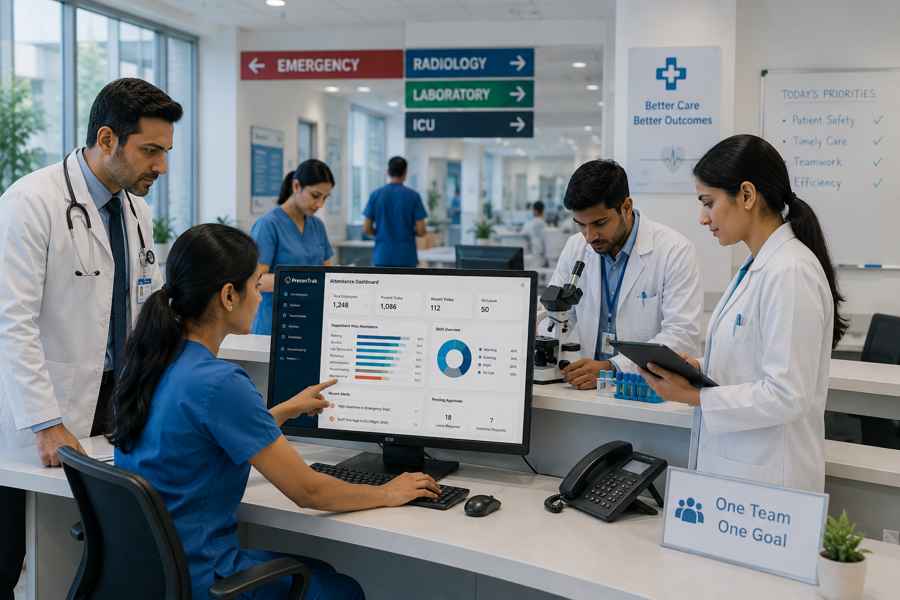
How Hospitals Can Simplify Staff Attendance and Payroll Management Without Increasing Administrative Work
How Hospitals Can Simplify Staff Attendance and Payroll Management Without Increasing Administrative Work
In Short
Managing employee attendance and payroll in hospitals is far more complex than in a typical office environment. Hospitals operate around the clock with doctors, nurses, technicians, administrative staff, housekeeping teams, security personnel, and support employees working across multiple shifts. Manual attendance records and disconnected payroll processes often increase administrative workload and the risk of payroll errors. Modern attendance and payroll software helps hospitals centralize attendance tracking, shift management, leave records, and payroll processing, allowing healthcare organizations to improve operational efficiency without adding more administrative work.
Introduction
Hospitals never truly stop operating.
Unlike many businesses that follow standard office hours, hospitals function 24 hours a day, seven days a week. Every shift change, emergency admission, staff replacement, and overtime request directly affects workforce planning and payroll management.
Managing attendance for a hospital is therefore much more than simply recording employee check-in and check-out times.
Hospital administrators must coordinate multiple departments, rotating shifts, emergency duty schedules, leave replacements, contractual staff, and payroll calculations while ensuring patient care remains uninterrupted.
As hospitals expand their workforce, manual attendance registers and spreadsheet-based payroll systems often become difficult to maintain accurately.
This is why many healthcare organizations are gradually moving toward integrated attendance and payroll software that simplifies workforce management while reducing administrative effort.
👉 Detailed article on Attendance and Payroll Software
👉 More details on Attendance & Payroll Software for Hospitals
Why Hospital Workforce Management Is Different
Hospital workforce management is fundamentally different from workforce management in most industries.
Unlike traditional offices where employees generally follow fixed working hours, hospitals operate continuously and require multiple employee categories to work together across different schedules.
A typical hospital workforce may include:
- Doctors
- Nursing staff
- Laboratory technicians
- Pharmacists
- Reception teams
- Administrative staff
- Housekeeping teams
- Security personnel
- Ambulance staff
- Maintenance employees
Each category often follows different attendance rules, shift timings, weekly offs, overtime policies, and payroll structures.
Managing all of these processes manually becomes increasingly difficult as the hospital grows.
Common Attendance Challenges Hospitals Face
Growing hospitals frequently experience similar workforce management challenges.
Multiple Shift Management
Morning, evening, night, rotating, and emergency shifts all require accurate attendance recording.
Without structured attendance management, shift-related payroll errors become increasingly common.
Emergency Duty Changes
Hospitals regularly adjust employee schedules based on emergencies, patient load, or staffing requirements.
Manual attendance systems often struggle to accurately reflect these changes.
Leave and Replacement Tracking
When nurses, technicians, or doctors take leave, replacement staff are frequently assigned.
Keeping accurate attendance records for these adjustments can become complicated without centralized systems.
Contractual and Permanent Employees
Many hospitals employ both permanent and contractual staff.
Managing attendance and payroll separately for different employee categories increases administrative workload.
Payroll Accuracy
Payroll calculations depend on accurate attendance records.
Incorrect attendance often results in:
- salary disputes
- overtime confusion
- incorrect deductions
- delayed payroll processing
Administrative Work Increases as Hospitals Grow
One of the biggest operational challenges hospitals face is that administrative work grows almost as quickly as employee count.
A hospital with 30 employees can often manage attendance manually.
A hospital with 150 or 300 employees usually cannot.
As workforce size increases, administrators spend more time:
- collecting attendance records
- verifying shifts
- calculating overtime
- correcting payroll errors
- maintaining employee records
Instead of supporting hospital operations, administrative teams become occupied with routine paperwork.
This is often the point where healthcare organizations begin evaluating digital workforce management systems.
👉 Attendance and Payroll Software: A Practical Guide for Growing Businesses in India
Why Attendance Accuracy Matters in Healthcare
Attendance management in hospitals affects much more than payroll.
Accurate attendance records help healthcare organizations improve:
- workforce planning
- shift coordination
- departmental staffing
- leave scheduling
- payroll accuracy
- operational transparency
Reliable attendance information allows administrators to make faster operational decisions while reducing manual verification work.
As hospitals continue expanding, attendance becomes an important operational management function rather than a simple HR activity.
Attendance and Payroll Solution For Different Industries.
Attendance & Payroll Software for Hospitals
Managing Multiple Shifts Without Creating Payroll Confusion
One of the biggest operational differences between hospitals and most other businesses is shift management.
Hospitals operate continuously, requiring staff to work across:
- Morning shifts
- Evening shifts
- Night shifts
- Rotational shifts
- Emergency duty
- Weekend schedules
- Public holidays
Each shift has different staffing requirements, attendance timings, overtime rules, and payroll implications.
For example, a nurse completing an extended emergency shift or a technician replacing a colleague at short notice creates attendance records that directly affect payroll calculations.
When these changes are recorded manually, payroll teams often spend significant time verifying attendance before salaries can be processed.
A centralized attendance and payroll system helps hospitals maintain accurate shift records while reducing administrative effort.
Overtime and Extra Duty Often Increase Payroll Complexity
Hospitals rarely operate according to predictable schedules.
Unexpected patient admissions, emergency surgeries, staff shortages, and seasonal healthcare demands often require employees to work additional hours.
Without accurate attendance records, hospitals may experience:
- overtime calculation errors
- delayed salary processing
- incorrect overtime payments
- employee disputes
- payroll adjustments after salary processing
Rather than manually reconciling attendance registers and spreadsheets, hospitals benefit from systems that maintain complete attendance histories linked with payroll processing.
How Small Businesses Can Save Time and Reduce Payroll Errors with Attendance and Payroll Software
Leave Management Becomes More Challenging in Hospitals
Employee leave management in hospitals is rarely straightforward.
Hospitals often need to manage:
- Casual leave
- Sick leave
- Emergency leave
- Compensatory leave
- Weekly offs
- Shift replacements
When one employee takes leave, another staff member often covers the shift.
If these attendance changes are not updated accurately, payroll calculations may become inconsistent.
A centralized leave management process helps administrators maintain accurate attendance while reducing manual coordination.
Why Payroll Processing Is More Complex for Healthcare Organizations
Payroll in hospitals is influenced by multiple operational factors.
Unlike organizations where employees work fixed office hours, hospital payroll often includes:
- Shift allowances
- Overtime
- Holiday duties
- Night shift adjustments
- Attendance-based salary calculations
- Leave deductions
- Incentives where applicable
As hospitals expand, maintaining these calculations manually becomes increasingly difficult.
This is why many healthcare organizations gradually move toward integrated attendance and payroll software.
👉 Payroll Compliance for Small Businesses in India: A Practical Guide
Attendance Verification Matters More Than Ever
Attendance accuracy directly affects payroll accuracy.
In busy healthcare environments, administrators often spend considerable time verifying:
- missed attendance entries
- duplicate records
- manual corrections
- shift adjustments
- replacement duties
These activities increase administrative workload without improving patient care.
Modern attendance verification methods help hospitals maintain reliable attendance records while reducing routine administrative work.
How Face Recognition Attendance Helps Hospitals
Hospitals experience a constant flow of employees entering and leaving different departments throughout the day.
Face recognition attendance systems help simplify this process by:
- improving attendance verification
- reducing manual attendance corrections
- minimizing proxy attendance
- supporting faster employee check-ins
- improving attendance accuracy
For growing hospitals, face recognition attendance also supports better payroll reliability because attendance data becomes more consistent.
👉 Why Businesses Are Moving Toward Face Recognition Attendance Systems for Better Workforce Management
Can GPS Attendance Help Hospitals?
GPS attendance is not required for every hospital employee.
However, it can be valuable for teams working outside the primary hospital premises.
Examples include:
- Home healthcare staff
- Ambulance teams
- Field medical representatives
- Community healthcare workers
- Outreach vaccination teams
- Diagnostic sample collection teams
For these employees, GPS attendance provides additional visibility while allowing administrators to verify attendance from different locations.
Hospitals can therefore manage both on-premise and field workforce attendance through a centralized system.
👉 Common GPS Attendance Mistakes Businesses Make and How to Avoid Them
Why Many Hospitals Are Moving Toward Digital Workforce Management
Hospital administrators are increasingly looking beyond attendance recording.
Their objective is to simplify overall workforce operations.
Digital attendance and payroll software helps hospitals:
- centralize employee records
- improve attendance accuracy
- simplify shift management
- reduce payroll errors
- improve reporting
- support workforce planning
Instead of managing multiple spreadsheets and registers, administrators can access workforce information from one platform.
As healthcare organizations continue expanding, this centralized approach helps reduce administrative work while improving operational visibility.
Operational Benefits Hospitals Often Experience
Hospitals implementing structured attendance and payroll processes frequently experience improvements such as:
Better Shift Visibility
Managers can understand staffing levels more quickly.
Improved Payroll Accuracy
Attendance records support more reliable payroll calculations.
Reduced Administrative Work
Less time spent correcting attendance and payroll records.
Better Workforce Planning
Accurate attendance data helps administrators plan staffing more effectively.
Improved Employee Transparency
Employees gain greater confidence in attendance records and payroll calculations.
What Should Hospitals Look for Before Choosing Attendance and Payroll Software?
Not every attendance and payroll solution is designed for the unique operational requirements of hospitals.
Unlike standard office environments, hospitals require software that can support multiple departments, rotating shifts, emergency staffing, payroll complexity, and workforce visibility without increasing administrative workload.
Before selecting a solution, hospital administrators should evaluate whether it supports both current operational needs and future expansion.
1. Flexible Shift Management
Hospitals rarely follow fixed working hours.
A suitable attendance and payroll solution should support:
- Morning, evening, and night shifts
- Rotational shift schedules
- Emergency shift allocation
- Holiday and weekend duty
- Overtime tracking
- Multiple department schedules
This flexibility helps administrators maintain accurate attendance while reducing manual scheduling adjustments.
2. Centralized Attendance and Payroll Management
Using separate tools for attendance, leave management, and payroll often creates unnecessary administrative work.
Hospitals should look for software that centralizes:
- Attendance tracking
- Payroll processing
- Leave management
- Employee records
- Shift information
- Workforce reporting
A single platform improves operational visibility and reduces duplicate data entry.
👉 Attendance and Payroll Software
3. Accurate Attendance Verification
Attendance accuracy directly affects payroll accuracy.
Hospitals should consider solutions that support modern attendance verification methods such as:
- Mobile attendance
- Face recognition attendance
- Biometric attendance
- Location-based attendance where appropriate
Reliable attendance records reduce payroll corrections and improve workforce transparency.
Why Businesses Are Moving Toward Face Recognition Attendance Systems for Better Workforce Management
4. Payroll Integration
Hospital payroll often includes multiple variables.
Software should be capable of supporting:
- Shift allowances
- Overtime calculations
- Attendance-based salary processing
- Leave deductions
- Employee payroll records
Integrated payroll processing helps reduce manual calculations while improving operational consistency.
👉 Payroll Compliance for Small Businesses in India: A Practical Guide
5. Reporting and Workforce Visibility
Hospital administrators require timely operational information.
Useful reporting features include:
- Daily attendance summaries
- Shift-wise attendance reports
- Leave reports
- Payroll reports
- Department-wise workforce data
Access to organized reports helps management make better staffing decisions.
Different Hospitals Have Different Workforce Needs
The requirements of a 25-bed hospital differ significantly from those of a multi-speciality healthcare organization.
Small Hospitals
Typically prioritize:
- Easy attendance tracking
- Payroll automation
- Leave management
- Employee records
Mid-Sized Hospitals
Often require:
- Department-wise attendance
- Shift management
- Payroll integration
- Workforce reporting
Large Hospitals
Usually benefit from:
- Multi-location workforce management
- Advanced shift scheduling
- Face recognition attendance
- Centralized payroll
- Comprehensive workforce analytics
Choosing software that can grow with the hospital helps avoid future operational disruption.
Comparison: Manual Management vs Digital Attendance and Payroll Software
| Operational Area | Manual Process | Digital Attendance & Payroll Software |
|---|---|---|
| Attendance Recording | Registers, spreadsheets | Automated attendance tracking |
| Shift Management | Manual scheduling | Centralized shift management |
| Payroll Calculation | Manual verification | Integrated payroll processing |
| Leave Management | Paper forms or Excel | Centralized leave management |
| Employee Records | Multiple files | Unified employee database |
| Attendance Accuracy | Prone to manual errors | Improved consistency |
| Administrative Work | High | Reduced through automation |
| Workforce Visibility | Limited | Real-time reporting |
The goal is not simply automation.
It is to create a more organized operational workflow that supports better workforce management.
How Presentrak Supports Hospital Workforce Management
Presentrak is designed to help growing organizations simplify attendance and payroll management while reducing administrative workload.
For hospitals, the platform can help centralize:
- Employee attendance
- Shift management
- Payroll processing
- Leave management
- Employee records
- GPS attendance (for field healthcare teams)
- Face recognition attendance
- Workforce reporting
Rather than maintaining separate systems for attendance and payroll, hospitals can manage workforce operations through a centralized platform designed for growing Indian businesses.
Supporting Different Hospital Departments
A hospital attendance system should work across multiple operational areas.
Examples include:
Nursing Departments
Managing rotational shifts and attendance.
Laboratory Teams
Recording department-specific attendance and shift schedules.
Administrative Departments
Simplifying attendance records and payroll processing.
Housekeeping Teams
Managing attendance across multiple duty schedules.
Security Personnel
Supporting continuous shift-based attendance.
Ambulance and Outreach Teams
Combining attendance management with GPS-based attendance where operationally appropriate.
This flexibility helps hospitals maintain consistency across departments without increasing administrative complexity.
Why This Matters for Growing Healthcare Organizations
As hospitals expand, administrative work often grows faster than expected.
Without structured attendance and payroll processes, administrators may spend increasing amounts of time:
- correcting attendance
- resolving payroll discrepancies
- updating employee records
- managing leave requests
- preparing workforce reports
Modern attendance and payroll software allows administrators to spend less time on repetitive administrative tasks and more time supporting hospital operations.
A Practical Roadmap for Hospitals Transitioning to Digital Attendance and Payroll Management
Implementing attendance and payroll software is not simply about replacing paper registers or spreadsheets.
For hospitals, the objective is to create a more organized workforce management process without disrupting daily healthcare operations.
The transition should be gradual, structured, and aligned with the hospital's operational workflow.
Step 1: Evaluate Current Attendance and Payroll Processes
Before selecting any system, hospitals should review their existing workflow.
Questions worth asking include:
- How is attendance currently recorded?
- How are shift changes managed?
- How is overtime calculated?
- How is leave approved?
- How much manual work is involved in payroll processing?
- Which departments experience the most attendance-related issues?
Understanding the current workflow helps identify operational improvements rather than simply introducing new technology.
Step 2: Identify Department-Specific Requirements
Every department within a hospital functions differently.
For example:
Nursing Department
Requires continuous shift scheduling and replacement management.
Emergency Department
Needs flexible attendance tracking for unpredictable workloads.
Laboratory
Often requires department-specific shift planning and attendance records.
Administrative Department
Focuses on payroll processing, reporting, and employee documentation.
Housekeeping & Security
Usually involve rotational shifts and attendance verification.
Understanding these operational differences helps hospitals select software that supports the entire organization rather than a single department.
Step 3: Centralize Workforce Information
One of the biggest operational improvements hospitals can make is reducing fragmented information.
Instead of maintaining:
- attendance registers
- Excel files
- payroll spreadsheets
- leave registers
- employee files
independently,
a centralized attendance and payroll system allows administrators to manage workforce information from one platform.
This reduces duplicate work and improves data consistency.
👉 Attendance and Payroll Software
Step 4: Train Staff Gradually
Successful implementation depends on employee adoption.
Hospitals should introduce new systems gradually by:
- training department heads
- explaining attendance procedures
- educating payroll administrators
- helping employees understand attendance methods
A phased approach minimizes operational disruption while improving long-term adoption.
Step 5: Monitor and Improve
Implementation is not the final step.
Hospitals should regularly review:
- attendance reports
- payroll accuracy
- shift utilization
- employee feedback
- administrative workload
Continuous improvement helps hospitals adapt workforce management processes as they grow.
Why Operational Simplicity Matters
Healthcare organizations already manage highly complex responsibilities.
Patient care, medical equipment, emergency response, compliance, staffing, and administration all compete for attention.
Attendance and payroll management should simplify operations rather than add another layer of administrative work.
This is why hospitals increasingly prefer practical systems that support:
- attendance tracking
- payroll processing
- shift management
- leave management
- employee records
through one integrated platform.
How Presentrak Supports Growing Hospitals
Presentrak is designed to help growing healthcare organizations simplify attendance and payroll management without increasing administrative workload.
The platform supports:
- Employee attendance tracking
- Shift-based workforce management
- Payroll processing
- Leave management
- Employee records
- GPS attendance for eligible field teams
- Face recognition attendance
- Attendance reporting
- Workforce visibility
Whether a hospital is managing one location or multiple departments, a centralized system helps improve operational consistency while reducing manual administrative effort.
👉 Explore More : Attendance & Payroll Software for Hospitals
Conclusion
Hospitals depend on well-coordinated teams working across departments, shifts, and emergency situations.
As workforce size grows, manual attendance registers, spreadsheets, and disconnected payroll processes often become difficult to manage accurately.
Modern attendance and payroll software provides hospitals with a practical way to simplify attendance tracking, shift management, payroll processing, employee records, and workforce reporting through a centralized platform.
Rather than increasing administrative work, the right system helps healthcare organizations create more organized, transparent, and scalable workforce management processes while allowing administrators to focus on supporting hospital operations.
Frequently Asked Questions
Why do hospitals need attendance and payroll software?
Hospitals operate around the clock with multiple departments, rotating shifts, and different employee categories. Attendance and payroll software helps simplify shift management, attendance tracking, payroll processing, and workforce administration from a centralized platform.
How does attendance software improve payroll accuracy in hospitals?
Payroll calculations depend on accurate attendance records. A centralized attendance system reduces manual errors, helping hospitals process salaries, overtime, leave deductions, and shift allowances more accurately.
Can attendance and payroll software handle hospital shift management?
Yes. Modern attendance and payroll software supports multiple shift schedules, rotational duties, overtime tracking, and department-wise workforce management, making it suitable for hospitals with complex staffing requirements.
Is face recognition attendance useful for hospitals?
Face recognition attendance can help hospitals improve attendance verification, reduce manual corrections, and maintain more reliable attendance records, especially in organizations with large workforces.
Can GPS attendance be used in hospitals?
GPS attendance may be useful for home healthcare teams, ambulance staff, community healthcare workers, and other employees who perform duties outside the primary hospital premises.
How can Presentrak help hospitals manage attendance and payroll?
Presentrak helps hospitals centralize employee attendance, payroll processing, shift management, leave records, employee information, GPS attendance, and face recognition attendance through one platform. This helps reduce administrative work while improving workforce visibility and payroll accuracy.
Is Presentrak suitable for small and mid-sized hospitals?
Yes. Presentrak is designed for growing organizations, including hospitals, that want to simplify attendance management, payroll processing, and workforce administration without adding unnecessary operational complexity.
Managing hospital staff attendance and payroll becomes more challenging as healthcare organizations grow.
If your hospital is looking for a practical way to simplify workforce management, improve payroll accuracy, and reduce administrative workload, explore how Presentrak's Attendance and Payroll Software can support your healthcare operations.
👉 Attendance and Payroll Software
👉 Attendance & Payroll Software for Hospitals
👉 Book a Free Demo